Showing posts with label racist. Show all posts

Sunday, June 17, 2018

The forcible separation of immigrant families being done in the name of the law

A Few Words About Separating Children From Their Parents
and What the Real Bible Has to Say About It
by Pastor Paul J. Bern
For better small screen or website viewing, click here :-)


By now most everyone has heard about the outrageous remarks made by White House Propaganda Minister (um, I meant Press Secretary) Sarah Huckabee Sanders. You know, when she said that since the Bible says we have to be law-abiding citizens, it's perfectly fine to forcibly separate children from their parents at America's southern border. Before I get too deep into this, let me give a partial quote from the original article.


White House cites Bible to defend child separation border policy
Sarah Sanders slammed for saying US-Mexico border policy was justified because it's 'biblical to enforce the law'.


(Al Jazeera News) “White House Press Secretary Sarah Sanders has seemingly invoked the Bible to justify the Trump administration's policy of separating children from migrants caught crossing the US-Mexico border, drawing anger and ridicule from many online. At a press briefing on Thursday evening, Sanders responded to a question put forward by CNN journalist Jim Acosta on US Attorney General Jeff Sessions' use of Christian scripture to justify detaining children separately from their parents. Acosta asked Sanders to point out where in the Bible the policy found its moral justification. "Where in the Bible does it say it is moral to take children away from their mothers?" he asked. Sanders responded: "I am not aware of the attorney general's comments or what he would be referencing ... I can say it is very biblical to enforce the law, that is repeated a number of times throughout the Bible." When pressed to point out a specific verse justifying the policy by Acosta, Sanders lashed out at the journalist. "I know it's hard for you to understand even short sentences I guess," she said, before going on to blame "loopholes" created by the Democrats for the policy. The comments from Sanders and the similar sentiment expressed by Sessions have earned the ire of many on social media.”


“Some cited biblical passages that emphasized the need to do justice by the poor and oppressed, while others pointed out the contradiction in justifying a policy, only to blame (the Democrats) for its existence..... "So, Sarah Huckabee Sanders is blaming Democrats for the Trump regime's ripping children away from their families and throwing them in prison camps whilst her and Jeff Sessions are citing the Bible to explain why it's all okay. They are about as Christian as Kim Jong Un is," wrote twitter user Ricky Davila.”


“The issue of child separation on the US-Mexico border has drawn widespread protests since it came to light last month..... In May, Attorney General Jeff Sessions reiterated the threat to prosecute those who made the crossing. "If you're smuggling a child, then we're going to prosecute you, and that child will be separated from you, probably, as required by law." The "zero tolerance" approach has drawn criticism from those on both sides of the political spectrum, including from the UN human rights office, which said the practice "amounts to arbitrary and unlawful interference in family life, and is a serious violation of the rights of a child". The number of interior removals - or deportations of those already in the US - grew by 37 percent during Trump's first year in office when compared with the same period in 2016, according to government data. Sessions has also recently come under fire for issuing a ruling that may make it nearly impossible for domestic abuse and gang violence survivors to seek asylum in the US.”


First of all, I assume you saw where this article came from – Al Jazeera! The reason I picked this article was to show you all you can't trust the American news media to tell you the real story. And the real story is that we now live in a country where many people – but not all, since people like myself practice unconditional love and compassion – think it's perfectly OK to forcibly separate children from their parents because they are allegedly “illegal aliens”. Let me remind Sarah Sanders, president Trump and Attorney General Jeff Sessions that there is no such thing as an illegal human being (“The earth is the Lord's, and everything in it”, Psalm 108: 1 and, “The whole earth is full of His glory”, Isaiah 6: 3). People have been coming to America illegally for 400 years, so this is nothing new. Some came on slave ships, but that was legal. So how come it's illegal to cross our borders when they are not slaves?


Moreover, America's northern border with Canada is at least as porous as its southern border, if not even more so. Nobody says a word about this. Do you know why? It's because Canadians are mostly white. Latino/Latina people are mostly brown. It's all about race, Jeff Sessions and Sarah Sanders and all those before you, the multitudes of bigots who insist that it's 'my way or the highway'. Nonwhite people please stay away from us Anglo's, they say when no one is around. Blacks and Hispanics are not welcome in many Caucasian neighborhoods, and would be told (not asked, mind you) to leave most conservative white churches. The state of American spirituality is pathetic indeed!


So what was the Bible passage Jeff Sessions and Sarah Sanders were quoting from? It was Romans chapter 13, the first 5 verses, and I quote: ““Everyone must submit himself to the governing authorities, for there is no authority except that which God has established. The authorities that exist have been established by God. Consequently, he who rebels against the authority is rebelling against what God has instituted, and those who do so will bring judgment on themselves. For rulers hold no terror for those who do right, but for those who do wrong. Do you want to be free from fear of the one in authority? Then do what is right and he will commend you. For he is God's servant to do you good. But if you do wrong, be afraid, for he does not bear the sword for nothing. He is God's servant, an agent of wrath to bring punishment on the wrongdoer. Therefore, it is necessary to submit to the authorities, not only because of possible punishment but also because of conscience. This is also why you pay taxes, for the authorities are God's servants, who give their full time to governing. Give everyone what you owe him: If you owe taxes, then pay taxes; if revenue, then revenue; if respect, then respect; if honor, then honor.”


There is another infamous person from history who quoted from that passage of scripture often to control the masses – Adolf Hitler. The problem with using this passage of Scripture in this context is that it says nothing about separating children from their parents. It sure as hell says nothing about locking children in cages away from their parents just after locking up their parents while the children watch helplessly. These poor kids will be traumatized for life by what's being done to them, and still more people will hate our country because of all these things. This is no way to run a country; separating parents from their children in the name of 'law and order'. Separating children from their parents is also unconstitutional because it's an 8th Amendment violation!


What are some additional examples of what the Bible says about the treatment of children? “Train a child in the way they should go, and when he gets older he will not forget about it”, (Proverbs22: 6) is one example. How can these incarcerated children learn when their parents are not there to teach them? Another example is Proverbs 29 verse 15, “A child left to himself disgraces his mother.” Jesus mentioned children on numerous occasions. One of his most memorable is from Matthew's gospel chapter 19, verse 14: “Let the little children come unto me, and do not hinder them. For I tell you truthfully, the kingdom of Heaven is made of such as these.” So you see, people, God made all the little children just like you and me. And God made these various children from various cultures, backgrounds, races and ethnicity's with different skin colors to teach us all about the richness of diversity, as well as teaching us to have some tolerance for those whose physical appearance and mannerisms are different than our own. Never forget that the same Almighty God has made us all!

Sunday, February 11, 2018

Passing the Dream Act is Very Compatible with Christianity

Immigration Reform, the Dream Act,
and Progressive Christianity
by pastor Paul J. Bern
To view this in any browser, click here :-)


This week's message revolves around the current topic of immigration reform, a.k.a. the “dreamers”, as opposed to what the Bible says. Not any particular government, faith or denomination, mind you, but none other than the Word of God! We have all heard more than enough from the American media 'presstitutes' regarding both sides of this issue as dictated by their Republican and Democrat masters. From conservative to progressive to liberal, as well as independent voters like myself who do not follow the crowd, the issue of 'illegal immigration' festers like an open wound across America without any first aid being applied. Like any other kind of serious wound, illegal immigration is an American political issue that needs immediate attention.


First let me say that I was formerly on the conservative side of this issue due to the fact that had once lost a good job in the computer/IT profession due to my being replaced by workers who had just arrived on H1B work visas. So, I was understandably bitter because I had lost my job to an imported worker despite the fact that I was more qualified. Actually it wasn't just myself either. The company I was working for at that time had laid off everyone in the branch office where I worked and replaced us all with a batch of workers from the Philippines with green cards. At the time I felt like my career had been stolen right out from under me, and all attempts to replace this job of mine had yielded only temporary jobs that lasted from several months duration to as little as one day.


Then one day in the early summer of 2008, I took yet another temporary job out in west Texas, and so I put most of my things in storage and left Atlanta for parts previously unknown to me. I had never been to Texas before, and I found a completely different culture than what I was accustomed to back in Atlanta. There were three things I noticed immediately soon after my arrival. The first was the oppressive heat and humidity, which made Atlanta seem mild by comparison. The second was that people ate burritos in place of burgers. There were burrito joints on nearly every corner and a few McDonald's, and that was just about it. The third thing I noticed was that approximately one third of the population was Hispanic (or Latino/Latina, take your pick). One of the first things I remember thinking when I realized that one third of the population spoke only Spanish was that this must be ground zero for so-called illegal immigration, or so I thought at the time.


But I spent four months out there in Texas, and as my days turned into weeks I began to notice little things that seemed insignificant in and of themselves. For example, I saw Latino men – and a few women as well – hanging around temp agencies, construction sites, and even at a U-haul truck rental company in the hopes of getting a job at least for that day. I remember being struck by the parallels between what those immigrants were having to endure as they searched for work and a piece of the so-called American dream compared to my own job search experiences. Some of these workers lived at homeless shelters, others in campers or vans, and the more prosperous ones lived in rented mobile homes or apartments. I saw the same thing day after day, with hundreds of workers gathered around in groups of as few as eight or ten, and as many as several dozen men and women. And so I found myself beginning to question my own intense dislike of these immigrant workers.


Before I go any further with this message, I think I should point out that my basis for resenting many of these immigrant workers was economic rather than racial, and more social than cultural. Nevertheless, my beliefs and opinions were heavily slanted towards an American rather than a more realistic world view, and so I found myself beginning to question my motives for feeling the way I did. One day soon after I did some research on-line and at the local library regarding this issue, and here is what I found out. The average worker in Mexico earns the equivalent of about $50.00 per month USD, and this is so because of reasons that I was previously only generally aware of – namely, the differences in currency valuation between the two countries, and the fact that Mexico is by and large a third world country that happens to border the United States. When you live in a third world country,m the workers earn third world level 'wages'.


When these same workers come to the US they make minimum wage, more or less, which is currently still stuck at only $7.25 per hour in Texas as well as Georgia. Some are paid substantially less while those who enforce the rules look the other way. Since a sizable chunk of these workers make less than minimum wage while being paid in cash under the table, I'm going to use a rounded out number of $7.00 hourly. A 40-hour work week at seven dollars an hour yields gross pretax earnings of $280.00 per week before taxes and Social Security. But since many of these workers don't work full time their take home pay is even less. At any rate, this works out to gross earnings of $1,120.00 per month for a 40 hour week. If each worker pays a regular tax rate as we Americans do, and many don't because their employers are cheating the tax man by paying in cash, they wind up with an average net take-home pay of approximately $740.00 per month.


I challenge anybody out there to try and live even for only a month on such substandard pay as this! Seven hundred stinking dollars – go ahead and try that! I challenge anybody who thinks they can live on such an absurdly small amount of money for an entire month, especially if you're a homeowner. In order to better understand this, instead of Mexico and the US being the two countries involved, let's use the US and Canada instead. If any given American working professional were offered a job in Canada, what would that be in relation to the US and Mexico? When we do the math, for any Mexican/Latino who emigrates to America, the jump from fifty bucks a month to 740 dollars equals a pay increase that is 11.4 times the going rate in Mexico or, for that matter, any central American country.


Now, let's contrast that to an American jumping ship and leaving the US to go and work and live in Canada. With an average net earnings of roughly $35,000.00 annually (before taxes) for American workers, if any of us were to be offered a job in Canada – or for that matter any other developed or emerging country worldwide – at 11.4 times the going rate here in the US, that would amount to an increase in take-home pay to $399,000.00 annually before taxes. OK, so let's ask ourselves a simple question: Would you or I be interested in a pay increase of 11.4 times the amount we have been earning previously? Without a doubt!! So, now you know why the Latino/Latina folks are migrating – legally or not – to the US in search of work. It's not because they are foreign invaders on an economic and social offensive to overrun America. It's because they are economic refugees from the third world who are searching for a better life for themselves and their families! So, instead of resenting or even hating this influx of foreign workers, the Christian thing to do would be to reach out to the Hispanic communities in all fifty states and minister to them. Like so many long-term unemployed here in America, they don't want a handout, they simply want to go to work. But I felt convicted in the Holy Spirit for harboring such negative and bitter thoughts, and I repented immediately and have never looked back. Sometimes it's best to simply admit we're wrong and move on. So let this be a cautionary lesson for everyone.


Showing compassion to foreigners and strangers is central to biblical teaching and morality, and there are quite a few people of faith who have started joining the fight to pass immigration reform, including myself. Congress needs to pass this into law because it is the morally right thing to do. Those who base their position on immigration reform on unacknowledged or hidden racial prejudice, irrational fear, or worries about losing elections to far-right ideologues are too often the same people who loudly proclaim their religious convictions as guiding their political decisions in violation of the First Amendment's separation of church and state. Politicians who are professing Christians need to consider what their faith has to say about immigration if they want to be considered authentic. If they oppose reform and refuse to offer compassion to our immigrant brothers and sisters, they should justify their positions on moral grounds (if they can). We join with other faith communities in asking for a moral and religious conversation about immigration reform – not just a political one. God's passionate, abiding concern for immigrants and foreigners, strangers and travelers – and for our neighbors – is obvious to anyone reading through Scripture.


It is the biblical call to "welcome the stranger" and Jesus' concern for "the least of these" that inspires and motivates us. "When a foreigner resides among you in your land, do not mistreat them. The foreigner residing among you must be treated as your native-born. Love them as yourself … " (Leviticus 19:33-34). The biblical word "ger" for the foreigners in our midst occurs an astounding 92 times in the Hebrew scriptures, with the consistent instruction to protect them. In the New Testament, the stranger, and all who are vulnerable, are at the very heart of the Gospel (Jesus' parable of the good Samaritan (see Luke 10, verses 25-37) is just one example of many). In the book of Matthew, Jesus offers a vision in which caring for foreigners is the defining mark of God's kingdom: "For I was hungry and you gave me something to eat, I was thirsty and you gave me something to drink, I was a stranger and you invited me in, I needed clothes and you clothed me, I was sick and you looked after me, I was in prison and you came to visit me" (Matthew 25:35-36). Now let me ask you all – when's the last time you did that for somebody? When's the last time you did any of the above for a stranger?


That evangelical as well as mainstream Christians would finally act to reform the immigration system should surprise no one who has a conscience, not just for theological reasons, but also for moral reasons. Undocumented immigrants have joined our congregations; we understand the problem firsthand. They are our brothers and sisters in the body of Christ. And we know that by reforming our immigration laws, we can create a system that also reflects the best values of our nation and the highest ideals of our faith. We act because, as the book of James reminds us, "faith without works is dead."


For me, I think the biggest change hasn't been in the pulpit, it's been in the pews and out in the streets. It's one thing when 11 million people are a statistic. But it's an entirely different matter when one of those 11 million is your friend, a human being who you now know as a neighbor, or as a co-worker or a worshiper. Our faith has always been about compassion and it compels us to do something. If we take the principle of compassion out of the Bible, it wouldn't be the Bible any more. Compassion is indeed all over the Bible. I pray it will also be found in the House of Representatives and the Senate, and in the workplace and our neighborhoods and subdivisions. It's time for Christians in and out of Congress to stand up in support of immigration reform, and for the Dreamers, or to explain why they won't — as Christians. If they follow their faith, we will see the miracle we need. And let's remember that there is no such thing as an illegal human being.

Friday, December 1, 2017

Free Book Excerpt #16 from Blogger and Author Rev. Paul J. Bern


legalization cover 1

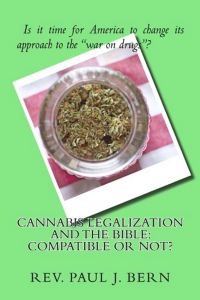
Another free sample from the latest book offering from Rev. Paul J. Bern; “Cannabis Legalization and the Bible: Compatible Or Not?”

Watch the video https://youtu.be/o_UXdIsBuf8


The United States likes to portray itself as the “Land of the Free”, yet a 2013 study by the ACLU found that one out of three people in the United States are arrested by the time they are 23! 1 out 3 arrested by the time they are 23?!? You want some more shameful stats? Last year there were more than 1.6 million people arrested on drug charges and over half of those arrests were for marijuana possession alone. With so many of our citizens in prison compared with the rest of the world, there are only two possibilities: Either we are home to the most evil people on earth or we are doing something much different – and vastly counterproductive. Obviously, the answer is the latter. It is time to find an exit strategy from our 40 year old war on drugs that is unquestionably a failure. Here's a few examples:


  • There are more African American adults under correctional control today – in prison or jail, on probation or parole – than were enslaved in 1850, a decade before the Civil War began.
  • As of 2004, more African American men were disenfranchised (due to felon disenfranchisement laws) than in 1870, the year the Fifteenth Amendment was ratified, prohibiting laws that explicitly deny the right to vote on the basis of race.
  • A black child born today is less likely to be raised by both parents than a black child born during slavery. The recent disintegration of the African American family is due in large part to the mass imprisonment of black fathers.
  • If you take into account prisoners, a large majority of African American men in some urban areas have been labeled felons for life. (In the Chicago area, the figure is nearly 80%.) These men are part of a growing under-caste – not class, caste – permanently relegated by law to a second-class status. They can be denied the right to vote, automatically excluded from juries, and legally discriminated against in employment, housing, access to education, and public benefits, much as their grandparents and great-grandparents were during the Jim Crow era.


The drug war has been brutal – complete with SWAT teams, tanks, bazookas, grenade launchers, and sweeps of entire neighborhoods – but those who live in white communities have little clue to the devastation wrought. This war has been waged almost exclusively in poor communities of color, even though studies consistently show that people of all colors use and sell illegal drugs at remarkably similar rates. In fact, some studies indicate that white youth are significantly more likely to engage in illegal drug dealing than black youth. Any notion that drug use among African Americans is more severe or dangerous is nullified by the data. White youth, for example, have about three times the number of drug-related visits to the emergency room as their African American counterparts. That is not what you would guess, though, when entering our nation’s prisons and jails, overflowing as they are with black and brown drug offenders. In some states, African Americans comprise 80%-90% of all drug offenders sent to prison. This is the point at which I am typically interrupted and reminded that black men have higher rates of violent crime. That’s why the drug war is waged in poor communities of color and not middle-class suburbs.


But what about all those violent criminals and drug kingpins? Isn’t the drug war waged in ghetto communities because that’s where the violent offenders can be found? The answer is yes – in made-for-TV movies. In real life, the answer is no. The drug war has never been focused on rooting out drug kingpins or violent offenders. Federal funding flows to those agencies that increase dramatically the volume of drug arrests, not the agencies most successful in bringing down the bosses. What gets rewarded in this war is sheer numbers of drug arrests. To make matters worse, federal drug forfeiture laws allow state and local law enforcement agencies to keep for their own use 80% of the cash, cars, and homes seized from drug suspects, thus granting law enforcement a direct monetary interest in the profitability of the drug market. The results have been predictable: people of color rounded up en masse for relatively minor, non-violent drug offenses. In 2005, four out of five drug arrests were for possession, only one out of five for sales. Most people in state prison have no history of violence or even of significant selling activity. In fact, during the 1990s – the period of the most dramatic expansion of the drug war – nearly 80% of the increase in drug arrests was for marijuana possession, a drug generally considered less harmful than alcohol or tobacco and at least as prevalent in middle-class white communities as in the inner city. In this way, a new racial under-caste has been created in an astonishingly short period of time – a new Jim Crow system. Millions of people of color are now saddled with criminal records and legally denied the very rights that their parents and grandparents fought for (and in some cases, died for). Affirmative action, though, has put a happy face on this racial reality. Seeing black people graduate from Harvard and Yale and become CEO's or corporate lawyers – not to mention the current president of the United States – causes us all to marvel at what a long way we’ve come. Recent data shows, though, that much of black progress is a myth. In many respects, African Americans are doing no better than they were when Martin Luther King, Jr. was assassinated and uprisings swept inner cities across America. The black child poverty rate is actually higher now than it was then. Unemployment rates in black communities rival those in Third World countries. And that’s with affirmative action! When we pull back the curtain and take a look at what our “colorblind” society creates without affirmative action, we see a familiar social, political, and economic structure: the structure of racial caste. The entrance into this new caste system can be found at the prison gate. This is not Martin Luther King, Jr.’s dream. This is not the promised land. The cyclical rebirth of caste in America is a recurring racial nightmare.


In a report published by reporter Tom McCarthy in The Guardian on Wednesday March 4th, 2015, police have killed more than twice as many people as reported by US government. According to this report, an average of 545 people killed by local and state law enforcement officers in the US went uncounted in the country’s most authoritative crime statistics every year for almost a decade. The first-ever attempt by US record-keepers to estimate the number of uncounted “law enforcement homicides” exposed previous official tallies as capturing less than half of the real picture. The new estimate – an average of 928 people killed by police annually over eight recent years, compared to 383 in published FBI data for the same time period – amounted to a more glaring admission than ever before of the government’s failure to track how many people police kill. 


The revelation called into particular question the FBI practice of publishing annual totals of “justifiable homicides by law enforcement” – tallies that are widely cited in the media and elsewhere as the most accurate official count of police homicides. This bureau of justice statistics (BJS) report, produced in collaboration with RTI International, the research institute, explodes the notion – if its findings are accurate – that the figures the FBI publishes annually are anything other than hugely misleading. The data underlying the FBI tally “is estimated to cover 46% of officer-involved homicides at best” for the years 2003-2009 and 2011, the BJS report concluded. But the published FBI tallies cover even fewer of the total deaths, closer to 41%, in part because the FBI publishes no data from Florida. A separate tally of “arrest-related deaths”, conducted by BJS itself, was slightly more accurate for the years in question, capturing 49% of law enforcement homicides, at best, the report found. The report estimated “an average of 928 law enforcement homicides per year” for the years in question, suggesting that the FBI’s published count of 414 such deaths in 2009, for example, might be 124% off, while its count of 347 such deaths in 2005 might be 167% off. The years under study saw several high-profile homicides by law enforcement of unarmed civilians, such as the 2009 shooting of Oscar Grant in a train station in Oakland, California – an episode that would become the subject of the award-winning film “Fruit vale Station” – and the 2006 killing of Sean Bell, who died in a hail of 50 bullets outside a nightclub in Queens, New York. But the majority of victims in law enforcement homicides for those years not only went unnamed – they went uncounted in any one tally. Even the two counting systems combined, as overseen by the FBI and BJS, missed an average of 263 homicides by law enforcement each year, BJS found.


Academics and specialists have long been aware of flaws in the FBI numbers, which are based on voluntary submissions by local law enforcement agencies of paperwork known as supplementary homicide reports. No law requires local agencies to fill out the reports, and some agencies do not, especially not for officer-involved homicides, according to experts who have studied the issue. But no accredited source had publicly ventured to claim that the numbers published by the FBI were more than 100% wrong. That’s notwithstanding an unusually public airing of doubts about the numbers by the FBI director, James Comey, in a 2015 speech at Georgetown University. “It’s ridiculous that I can’t tell you how many people were shot by the police in this country – last week, last year, the last decade – it’s ridiculous,” Comey said. While the FBI and other government tallies have long been criticized for under-reporting, an admission of the problem at the top levels of US government is swiftly emerging. Joining Comey and Obama this year has been the outgoing attorney general, Eric Holder, who in January 2016 called the government’s accounting for use of force “unacceptable”. In a highly anticipated investigation of its own, Holder’s Justice Department released a report the following Wednesday that African Americans were subject to a full 88% of use-of-force cases actually documented by the police in Ferguson, Mo., according to a law enforcement official familiar with the department’s findings.


I have presented everything in this book the way I have to reveal the government's not-so-surprising rationale for America's extremist drug laws – race. The first anti-drug law in our country was a local law in San Francisco passed in 1875. It outlawed the smoking of opium and was directed at the Chinese because opium smoking was a peculiarly Chinese habit. It was believed that Chinese men were luring white women to have sex in opium dens. In 1909 Congress made opium smoking a federal offense by enacting the Anti-Opium Act. It reinforced Chinese racism by carving out an exception for drinking and injecting tinctures of opiates that were popular among whites. Cocaine regulations also were triggered by racial prejudice. Cocaine use was associated with African-Americans just as opium use was associated with the Chinese. Newspaper articles bore racially charged headlines linking cocaine with violent, anti-social behavior by blacks. A 1914 New York Times article proclaimed: "Negro Cocaine 'Fiends' Are a New Southern Menace: Murder and Insanity Increasing Among Lower Class Blacks Because They Have Taken to 'Sniffing.'" A Literary Digest article from the same year claimed that "most of the attacks upon women in the South are the direct result of the cocaine-crazed Negro brain." It comes as no surprise that 1914 was also the year Congress passed the Harrison Tax Act, effectively outlawing opium and cocaine.


Marijuana prohibition also had racist underpinnings. This time it was the Mexicans. Just as cocaine was associated with black violence and irrational behavior, in the southwest border towns marijuana was viewed -- beginning in the early 1920s -- as a cause of Mexican lawlessness. A Texas police captain from that time period suggested that marijuana gave Mexicans superhuman strength to commit acts of violence: “Under marijuana Mexicans [become] very violent, especially when they become angry and will attack an officer even if a gun is drawn on him. They seem to have no fear. I have also noted that under the influence of this weed they have enormous strength and it will take several men to handle one man while, under ordinary circumstances, one man could handle him with ease.” The American Coalition – an anti-immigrant group – claimed as recently as 1980: "Marijuana, perhaps now the most insidious of narcotics, is a direct byproduct of unrestricted Mexican immigration."


Since then Congress has enacted a spate of comprehensive anti-drug laws with strict penalties. For example, today one can be sentenced to life for distributing one kilogram of heroin; 40 years for distributing 100 grams, and 20 years for distributing any quantity at all. Nevertheless, this has not stemmed the country's appetite for illicit drugs in spite of every administration's continued "war on drugs" since President Nixon established the Drug Enforcement Agency in 1972, which has grown through the years to a staff of almost 10,000 employees and a budget of $2 billion annually. According to data from the 2010 National Household Survey on Drug Use and Health, almost 120 million Americans 12 or older – roughly 47 percent of that population – reported illicit drug use at least once in their lifetime; 15.3 percent admitted to using an illegal drug in the prior year; and 8.9 percent – roughly 23 million people – did it within the prior month. The New York Times recently reported that one out of every 15 high school students smokes marijuana on a nearly daily basis. When it comes to sentencing, the main culprit is drugs. About half of the roughly 220,000 criminals in the federal prisons have either brought them into our country, have distributed them here, or have otherwise associated themselves with this illicit activity. This means that probably half of the $6.8 billion of the Bureau of Prisons budget is eaten up by incarcerating the criminal druggies. Half of the prison population is there because of drugs, costing us billions of dollars a year to keep them in jail.

Buy direct (print edition reduced to $9.95, 200 pages) at http://www.pcmatl.org/#!books-and-donations/c17et


Get it on Smashwords.com (all Apple/Mac devices, Nook, Kobo, Fire and more) at https://www.smashwords.com/books/view/666084

Sunday, August 13, 2017

Charlottesville, Va. and the Apostle John

Racism and “White Nationalism” Have No Place
in 21st Century America
by Pastor Paul J. Bern
To view this in any browser, click here! :-)


I once saw a one-hour documentary on cable TV (back in the days when I still watched TV) that was all about neo-Nazi skinheads, their swastika tattoos and flags, and how they are organized into gangs that operate outside the law. The extreme racial hatred of these people was chronicled by this cable channel in raw detail. It showed how these organizations recruit new members over the Internet, and how they support themselves by selling drugs and guns. I clearly remember how appalled I was as I watched this documentary with all the hate and violence perpetrated by these racist organizations. It made me think about the first book of John in the New Testament and what it says about those who harbor racist hate.


“Anyone who claims to be in the light but hates his brother is still in darkness. Whoever loves his brother lives in the light, and there is nothing in him to make him stumble. But whoever hates his brother is in the darkness and walks around in the darkness; he does not know where he is going because the darkness has blinded him.” (1st John 2, verses 9-11) Fast forward to the present, and we had a very public example this past week of politicized, racist behavior in connection with the riots in Charlottesville, Va. this past Friday and Saturday. So-called “white nationalists” put on this big public demonstration and parade, and all the while there were equally numerous anti-bigotry counter-protesters, resulting in an inevitable clash between the two that would up on global TV news outlets. The death toll from these incidents has just risen to 3 as I write this. Was it really worth 3 human lives just so hatred and intolerance could be better expressed? I think not!!


Ask people if they love God or not and the vast majority will say yes, excluding the atheists. (Atheists have themselves as their own gods, so they engage in what amounts to self-worship.) Yet how many of us harbor hate, intolerance and mistrust towards groups of people who are different from us for various reasons? Religion, race, nationality, age, gender, sexual orientation and especially differences in economic status are some of the most common examples. We can't love God and at the same time hate that which He has created. This can range from laughing at a racial joke all the way up to mass murder in schools, churches or movie theaters. The underlying message implied by these things is that there are some people who think that they are somehow better than everybody else. “I think I'm better than you”, is the basis for their opinions, and that's wrong! God created us all and He sees us as equals, as it is written: “Rich and poor have this in common; the Lord is the Maker of them all.” (Proverbs 22: 2)


It is high time for these condescending, racist “white nationalist” people to begin seeing themselves as peers as God has commanded us to! Otherwise, things can go terribly wrong in a hurry, as we have already seen on TV. In this next quote the apostle John, the younger half-brother of Jesus, takes this a step further. “If anyone says,'I love God', yet hates his brother, he is a liar. For anyone who does not love his brother, whom he has seen, cannot love God, whom he has not seen. And He has given us this command: whoever loves God must also love his brother.” (1st John 4, verses 20-21)


If there is one thing we can say about this passage of Scripture, it is that John tells it like it really is. He minces no words with this last quote, “whoever loves God must also love his brother”. That was not just an idea or a suggestion. This is how we are to be conducting ourselves in everyday living. If we love God, then we are to love that which he has created. “For anyone who does not love his brother, whom he has seen, cannot love God, whom he has not seen”. It's hard to get any more blunt and direct than that. So, people who are racially prejudiced and hate-filled but still go to church, do so in vain! They are committing a gross injustice against people of color by their racism, which is why racism is an injustice in God's eyes! Does the Bible have anything else to say about injustice? In fact it has volumes of commentary and Godly commands that humankind is charged with the task of following. Isaiah 30, verse 18 says, “Yet the Lord longs to be gracious to you; He rises to show you compassion. For the Lord is a God of justice. Blessed are all who wait for him!”. Zechariah chapter 7, verse 9 says, “Administer true justice; show mercy and compassion to one another.” Here is one Bible verse that I can truly say a certain Texas state trooper violated when he racially profiled Sandra Bland due to her broken tail-light and Black complexion back in 2015. That, combined with her out-of-state tag, made that officer indirectly responsible for her untimely demise. I wonder how he sleeps at night?


There are many varieties of bigotry, intolerance and prejudice. It can be racial. Do you hate black or white people? What about the Latino immigrants, who are in fact economic refugees from Mexico and Central America? It can be gender-based. Are you a guy who hates women or vice verse? There are people like that, more than one might think. Speaking of sex, do you hate gay people? We may not agree with their lifestyle, and many say they are in sin, but that doesn't give us the right to despise them. Although we believe the Bible says homosexuality is a sin as the majority of Christians do, that give us no license to hate the sinner. Just because they are different than you doesn't make them any worse or yourself any better. Sexual sin is still sexual sin, and questions about same-sex as opposed to opposite sex attraction are, to me, besides the point. The same goes for age discrimination. Ask any older worker who has been turned down for a job in favor of a younger candidate to describe that experience. I've walked a mile in those shoes myself. What about homeless people? Do you tend to not tolerate or fear the homeless? What about the mentally ill? Moreover, economic discrimination is the worst kind of prejudice because it affects the largest group of people, since 99% of America's wealth is squarely in the hands of the top 1% of the US population. What is the antidote for this social sickness? How do we overcome all the artificial barriers that constitute hate, intolerance and prejudice? How can we put forth fundamental change in these areas? For the answer to this pressing question, let's refer one last time to the apostle John.


“Dear friends, let us love one another, for love comes from God. Everyone who loves has been born of God and knows God. Whoever does not love does not know God, because God is love. This is how God showed His love among us: He sent his one and only Son into the world that we might live through Him. This is love: not that we loved God, but that He loved us and sent his Son as an atoning sacrifice for our sins. Dear friends, since God so loved us, we also ought to love one another. No one has ever seen God; but if we love one another, God lives in us and His love is made complete in us....There is no fear in love. But perfect love drives out fear, because fear has to do with punishment. The one who fears is not made perfect in love. We love because He first loved us.” (1st John 4; verses 7-12, 18-19)


Love is the perfect eraser for hate. Bigotry, intolerance and prejudice are based on fear – fear of what we don't understand – and hate, which itself is pure evil because it is derived from contempt. To overcome this, try volunteering in an inner city ministry where you live, or maybe at a food bank or in a homeless shelter, or at the church you attend. It will open your eyes to a whole different world. Hunger in America is real, near-panic over America's future is too, and they are ever-present. The middle class is disappearing because big multinational corporations have exported all the good middle class jobs for pennies on the dollar to emerging countries and economies worldwide. At this point, the only thing left that “we the people” can do about it is an outright revolt, but the violence in Charlottesville, Va. was not the way to go about it! Instead, our churches should be a very good places to start, whether it be for ministry, community outreach or even outright revolution (think “Black Robed Regiment” from the US Revolutionary war). But, if churches aren't your first choice, there are lots of other nonprofits out there such as Goodwill, the Veterans Association and so on. Better yet, start a movement of your own. By volunteering or being a missionary in the poorest parts of your city or town, that is just one way we can combat racism and poverty as an entire nation. From this kind of a ministry we can gain understanding, from understanding tolerance, from tolerance compassion, and from compassion empathy. These are the antidotes for racism, bigotry, prejudice and intolerance. This is how we as a nation can stop hate in its tracks. This is how we as a united American people can ensure there are no more Sandra Bland's (RIP kid sister, you are not forgotten) or Charlottesville, Virginia's. Hate is no longer OK, it isn't even tolerable for those with a strong sense of conscience and a deep desire for justice. You will be surprised at what a positive effect this can have on your outlook on life. It works for me! And the God of peace, a holy peace that is beyond normal human comprehension, will be with you all when you do so.


Wednesday, August 9, 2017

Book excerpt #5 from my recent release, "Cannabis Legalization and the Bible: Compatible or Not?"

"Cannabis Legalization and the Bible: Compatible or Not?" written and published by Rev. Paul J. Bern

Now available in audio too, simply click here! :-)
Watch the video at https://youtu.be/o_UXdIsBuf8


legalization cover 1

The War On Drugs does more harm than good Here we are, well over four decades after Richard Nixon declared the war on drugs in 1971 and $1 trillion spent since then. What do we have to show for it? The U.S. has the largest prison population in the world, with about 2.3 million behind bars. Well over half a million of those people are incarcerated for a drug law violation. What a waste of space and human life! In business, if one of our companies is failing, we take steps to identify and solve the problem. What we don't do is continue failing strategies that cost huge sums of money and exacerbate the problem. Rather than continuing on the disastrous path of the 'war on drugs', the world needs to look at what works and what doesn't in terms of real evidence and data. The facts are overwhelming. If the global drug trade were a country, it would have one of the top 20 economies in the world. In 2005, the United Nations estimated the global illegal drug trade is worth more than $320 billion, and that was 11 years ago as of this writing. It also estimates there are 230 million illegal drug users in the world, yet 90% of them are not classified as problematic. In the United States, if illegal drugs were taxed at rates comparable to those on alcohol and tobacco, they would yield $49.7 billion in tax revenue. Moreover, the Cato study says legalizing drugs would save the U.S. an additional $41 billion a year in enforcing the drug laws.

Have U.S. drug laws reduced drug use? No, it's exactly the opposite. The U.S. is the No. 1 nation in the world in illegal drug use. As with Prohibition, banning alcohol didn't stop people drinking, it just stopped people from obeying the law. About 40,000 people were in U.S. jails and prisons for drug crimes in 1980, compared with more than 540,000 today. Excessively long prison sentences and locking up people for small drug offenses contribute greatly to this ballooning of the prison population. It also represents racial discrimination and targeting disguised as drug policy. People of color are no more likely to use or sell illegal drugs than white people – yet from 1980 to 2007, blacks were arrested for drug law violations at rates 2.8 to 5.5 times higher than white arrest rates. Prohibition failed when the American people spoke up and demanded its repeal. Today, the American people are showing their visceral dissatisfaction with the 'war on drugs' by voting for change, often in the face of federal law. Colorado and Washington recently became the first U.S. states to legalize recreational use of marijuana. Eighteen states and the District of Columbia allow the medical use of marijuana, and 74% of Americans support alternatives to locking people up for marijuana possession.

What does the Bible say about making a creation of Almighty God's illegal or immoral? This book uncovers the ugly truth about America's 'Drug War', while disproving all the myths and government propaganda about medical marijuana. In this book you will discover the following:
  • America's drug war is based on racism and illegality on the part of government, and particularly law enforcement.
  • The private prison industry is raking in billions of US taxpayer money because of the 'drug war'.
  • Alcohol, tobacco, prescription pain killers and codeine are all at least 5 times more dangerous than marijuana.
  • The pharmaceutical industry, as well as law enforcement, benefit financially from the drug war.
  • The federal government has been lying for decades about the addictive properties of medical marijuana. Cannabis has been repeatedly proven in study after study to be non-addictive.
This book blows the lid off the “War On Drugs” while proving conclusively that the 'drug war' is actually an all-out war on the American people. Our time to rise up has come.
Also available on Kindle, Nook, Apple and Smashwords.com

Sunday, August 6, 2017

The immigration debate, president Trump and the Bible

The Progressive Christian Approach

to Immigration Reform

by Pastor Paul J. Bern
To view this in any browser, click here! :-)


My message for today revolves around what the media and our politicians are saying regarding the topic of immigration reform, as opposed to what the Bible says. We have all heard both sides of this issue from Republicans and Democrats, from conservative to progressive to liberal, as well as independent voters like myself. President Trump went on the record earlier this week to advocate for even tighter immigration requirements than those already in place. I myself was formerly on the conservative side of this issue due to the fact that had once lost a good job in the computer/IT profession due to my being replaced by foreign workers despite the fact that I was more qualified.


Then one day in the late spring of 2008, I took a contract job out in west Texas under very favorable terms for myself. So, I put most of my things in storage with the intention of coming back to Atlanta where I live after my contract job expired. I had never been to Texas before, and I found a completely different culture than what I was accustomed to back east. There were three things I noticed immediately soon after my arrival. The first was the oppressive heat and humidity, the second was that people ate burritos in place of burgers, and the third was that approximately one third of the population was Latino. The first thing I remember thinking when I saw that one third of the population spoke only Spanish was that this must be ground zero for 'illegal immigration', or so I thought at the time.


But I spent four months out there in Texas, and as my days turned into weeks I began to notice seemingly insignificant little things that began adding up to something much more. For example, I saw Latino men – and a few women as well – hanging around temp agencies, construction sites, and even at a U-haul truck rental company in the hopes of getting a job at least for that day. I remember being struck by the parallels between what those Latino folks were having to endure as they searched for work, and a piece of the so-called 'American dream', compared to my own previous job search experiences. Some of these workers lived at homeless shelters, others in campers or vans, and the more prosperous ones lived in rented mobile homes or apartments. I saw the same thing day after day, with hundreds of workers gathered around in groups of as few as eight or ten, and as many as several dozen. And so I found myself beginning to question my own intense dislike of these immigrant workers. I mean, all they really wanted was a chance at a new life in a safer and cleaner environment. What's wrong with that?


Before I go any further with this message, I think I should point out that my basis for resenting many of these immigrant workers was economic rather than racial. Nevertheless, thanks to my “education”, my beliefs and opinions had been heavily slanted towards an American rather than a world view. So I found myself beginning to question my own motives for feeling the way I did. As I did some research on-line, what I found explained the cognitive dissonance between what I had been “taught” and what I saw. The average worker in Mexico earns the equivalent of about $50.00 per month USD. When these same workers come to the US they make minimum wage, more or less, which is currently still stuck at only $7.25 per hour here in Georgia. Since a sizable chunk of these workers make less than minimum wage while being paid in cash under the table, I'm going to use a rounded out number of $7.00 hourly for the whole country. A 40-hour work week at seven dollars an hour yields gross pretax earnings of $280.00 per week before taxes and Social Security. But since many of these workers don't work full time their take home pay is even less. At any rate, this works out to gross earnings of $1,120.00 per month. If each worker pays a regular tax rate as we Americans do, and many don't because their employers are cheating the tax man by paying in cash, they wind up with an average net take-home pay of approximately $740.00 per month. But when you compare that to making only $50.00 (USD) in Mexico, $740.00 must seem super-tantalizing to our Latino brothers and sisters.


I challenge anybody out there to try and live even for only a month on substandard pay such as this! The bottom line is that this is impossible while still meeting our monthly expenses in a timely manner. In order to better understand this, instead of Mexico and the US being the two countries involved, let's use the US and Canada instead. If any given American working professional were offered a job in Canada, what would that be in relation to the US and Mexico? For any Mexican/Latino who emigrates to America, the jump from fifty bucks a month to 740 dollars equals a pay increase that is 11.4 times the going rate in Mexico or, for that matter, any Central or South American country. Now, let's contrast that to an American jumping ship and leaving the US to go and work and live in Canada. With an average net earnings of $35,000.00 annually (before taxes) for American workers, if any of us were to be offered a job in Canada – or for that matter any other developed or emerging country worldwide – at 11.4 times the going rate here in the US, that would amount to an increase in take-home pay to $399,000.00 annually before taxes!


OK, so let's ask ourselves a simple question: Would you or I be interested in a pay increase of 11.4 times the amount we have been earning previously? The obvious answer is, of course we would! So, now you know why the Latino folks are migrating – legally or not – to the US in search of work. It's not because they are foreign invaders on an economic and social offensive to overrun America like certain people always say. It's because they are economic refugees from the third world who are searching for a better life for themselves and their families! So, instead of resenting or even hating this influx of foreign workers, the Christian thing to do would be to reach out to the Latino communities in all fifty states and minister to them. I don't mean giving them a handout, either. Like so many long-term unemployed here in America, they don't want a handout, they simply want to go to work. But I felt convicted in the Holy Spirit for previously harboring such negative and bitter thoughts, and I have long since repented of this.


Showing compassion to foreigners and strangers is central to biblical teaching and morality. “Do not mistreat an alien or oppress him, for you were aliens in Egypt.” (Exodus 22: 21) Moreover, there are quite a few Christians who have started joining the fight to pass immigration reform, including myself. Congress needs to pass immigration reform into law because it is the morally right thing to do. Those whose position on reform is based on political fear, unacknowledged racial prejudice or worries about losing primaries to far-left ideologues are too often the same people who trumpet their religious convictions as guiding their decisions in public life – in violation of the First Amendment's separation of church and state! Politicians who are professing Christians need to consider what their faith has to say about immigration. If they oppose reform and refuse to offer shelter or compassion to our immigrant brothers and sisters, they should (hopefully) begin asking themselves why. We must join with other faith communities in asking for a moral and religious conversation about immigration reform – not just a political one. God's passionate, abiding concern for immigrants and foreigners, strangers and travelers – and for our neighbors – is obvious to anyone reading through Scripture.


It is the Biblical call to "welcome the stranger" and Jesus' concern for "the least of these" that inspires and motivates us. "When a foreigner resides among you in your land, do not mistreat them. The foreigner residing among you must be treated as your native-born. Love them as yourself." (Leviticus 19:33-34). In the New Testament, the stranger, and all who are vulnerable, are at the very heart of the Gospel (Jesus' parable of the good Samaritan is just one example of many). In the book of Matthew, Jesus offers a vision in which caring for them is the defining mark of God's kingdom: "For I was hungry and you gave me something to eat, I was thirsty and you gave me something to drink, I was a stranger and you invited me in, I needed clothes and you clothed me, I was sick and you looked after me, I was in prison and you came to visit me." (Matthew 25:35-36).


That evangelical as well as mainstream Christians would finally act to reform the immigration system should surprise no one, and not just for theological reasons. Undocumented immigrants have joined our congregations; we understand the problem firsthand. They are our brothers and sisters in the body of Christ. And we know that by reforming our immigration laws, we can create a system that also reflects the best values of our nation and the highest ideals of our faith. We act because, as the book of James reminds us, "faith without works is dead."


For me, I think the biggest change hasn't been in the pulpit, it's been in the pews and out in the streets. It's one thing when 11 million people are a statistic. But it's other thing altogether when one of those 11 million is your friend, a human being who you now know as a father, as a husband, as a mother, as a co-worker, or as a worshiper. Our faith has always been about love, empathy and compassion. It compels us to do something, putting others before ourselves. If we take the principle of compassion out of the Bible, it wouldn't be the Bible any more. Compassion is indeed all over the Bible, it's written in between every line! I pray it will also be found in the White House, the House of Representatives and the Senate. It's time for Christians in Congress to stand up in support of immigration reform, or to explain why they won't — as Christians. If they follow their faith, we will see the miracle we need. And let's remember that there is no such thing as an illegal human being. Everybody has the right to be here.

Sunday, April 9, 2017

It's Been 50 Years Ago This Week, and Things Are Worse Than Ever

“After Vietnam” 50 Years Later
by Pastor Paul J. Bern


The fiftieth anniversary of Rev. Dr. Martin Luther King, Jr.'s much-beloved (right wing extremists excluded) speech, “After Vietnam” occurred this past week. To commemorate this famous speech I will be posting this slightly condensed version today, particularly in view of the fact that it is at least as relevant today as it was back then.


MLK's “After Vietnam” Speech at Riverside Church, Harlem, N.Y. (1967)


I need not pause to say how very delighted I am to be here tonight, and how very delighted I am to see you expressing your concern about the issues that will be discussed tonight by turning out in such large numbers.... And of course, it’s always good to come back to Riverside church. Over the last eight years, I have had the privilege of preaching here almost every year in that period, and it is always a rich and rewarding experience to come to this great church and this great pulpit. I come to this magnificent house of worship tonight because my conscience leaves me no other choice. I join you in this meeting because I'm in deepest agreement with the aims and work of the organization which has brought us together: Clergy and Laymen Concerned About Vietnam. The recent statements of your executive committee are the sentiments of my own heart, and I found myself in full accord when I read its opening lines: "A time comes when silence is betrayal." And that time has come for us in relation to Vietnam.


The truth of these words is beyond doubt, but the mission to which they call us is a most difficult one. Even when pressed by the demands of inner truth, men do not easily assume the task of opposing their government's policy, especially in time of war. Nor does the human spirit move without great difficulty against all the apathy of conformist thought within one's own bosom and in the surrounding world. Moreover, when the issues at hand seem as perplexing as they often do in the case of this dreadful conflict, we are always on the verge of being mesmerized by uncertainty; but we must move on. And some of us who have already begun to break the silence of the night have found that the calling to speak is often a vocation of agony, but we must speak. We must speak with all the humility that is appropriate to our limited vision, but we must speak. And we must rejoice as well, for surely this is the first time in our nation's history that a significant number of its religious leaders have chosen to move beyond the prophesying of smooth patriotism to the high grounds of a firm dissent based upon the mandates of conscience and the reading of history. Perhaps a new spirit is rising among us. If it is, let us trace its movements and pray that our own inner being may be sensitive to its guidance, for we are deeply in need of a new way beyond the darkness that seems so close around us.


Over the past two years, as I have moved to break the betrayal of my own silences and to speak from the burning of my own heart, as I have called for radical departures from the destruction of Vietnam, many persons have questioned me about the wisdom of my path. At the heart of their concerns this query has often loomed large and loud: "Why are you speaking about the war, Dr. King?" "Why are you joining the voices of dissent?" "Peace and civil rights don't mix," they say. "Aren't you hurting the cause of your people," they ask? And when I hear them, though I often understand the source of their concern, I am nevertheless greatly saddened, for such questions mean that the inquirers have not really known me, my commitment or my calling. Indeed, their questions suggest that they do not know the world in which they live.


In the light of such tragic misunderstanding, I deem it of signal importance to try to state clearly, and I trust concisely, why I believe that the path from Dexter Avenue Baptist Church – the church in Montgomery, Alabama, where I began my pastorate – leads clearly to this sanctuary tonight. I come to this platform tonight to make a passionate plea to my beloved nation. This speech is not addressed to Hanoi or to the National Liberation Front. It is not addressed to China or to Russia. Nor is it an attempt to overlook the ambiguity of the total situation and the need for a collective solution to the tragedy of Vietnam. Neither is it an attempt to make North Vietnam or the National Liberation Front paragons of virtue, nor to overlook the role they must play in the successful resolution of the problem. While they both may have justifiable reasons to be suspicious of the good faith of the United States, life and history give eloquent testimony to the fact that conflicts are never resolved without trustful give and take on both sides.


Tonight, however, I wish not to speak with Hanoi and the National Liberation Front, but rather to my fellow Americans. Since I am a preacher by calling, I suppose it is not surprising that I have seven major reasons for bringing Vietnam into the field of my moral vision. There is at the outset a very obvious and almost facile connection between the war in Vietnam and the struggle I, and others, have been waging in America. A few years ago there was a shining moment in that struggle. It seemed as if there was a real promise of hope for the poor – both black and white – through the poverty program. There were experiments, hopes, new beginnings. Then came the buildup in Vietnam, and I watched this program broken and eviscerated, as if it were some idle political plaything of a society gone mad on war, and I knew that America would never invest the necessary funds or energies in rehabilitation of its poor so long as adventures like Vietnam continued to draw men and skills and money like some demonic destructive suction tube.


So, I was increasingly compelled to see the war as an enemy of the poor and to attack it as such. Perhaps a more tragic recognition of reality took place when it became clear to me that the war was doing far more than devastating the hopes of the poor at home. It was sending their sons and their brothers and their husbands to fight and to die in extraordinarily high proportions relative to the rest of the population. We were taking the black young men who had been crippled by our society and sending them eight thousand miles away to guarantee liberties in Southeast Asia which they had not found in southwest Georgia and East Harlem. And so we have been repeatedly faced with the cruel irony of watching Negro and white boys on TV screens as they kill and die together for a nation that has been unable to seat them together in the same schools. And so we watch them in brutal solidarity burning the huts of a poor village, but we realize that they would hardly live on the same block in Chicago. I could not be silent in the face of such cruel manipulation of the poor.


My third reason moves to an even deeper level of awareness, for it grows out of my experience in the ghettos of the North over the last three years – especially the last three summers. As I have walked among the desperate, rejected, and angry young men, I have told them that Molotov cocktails and rifles would not solve their problems. I have tried to offer them my deepest compassion while maintaining my conviction that social change comes most meaningfully through nonviolent action. But they ask – and rightly so – what about Vietnam? They ask if our own nation wasn't using massive doses of violence to solve its problems, to bring about the changes it wanted. Their questions hit home, and I knew that I could never again raise my voice against the violence of the oppressed in the ghettos without having first spoken clearly to the greatest purveyor of violence in the world today – my own government. For the sake of those boys, for the sake of this government, for the sake of the hundreds of thousands trembling under our violence, I cannot be silent. For those who ask the question, "Aren't you a civil rights leader?" and thereby mean to exclude me from the movement for peace, I have this further answer. In 1957 when a group of us formed the Southern Christian Leadership Conference, we chose as our motto: "To save the soul of America." We were convinced that we could not limit our vision to certain rights for black people, but instead affirmed the conviction that America would never be free or saved from itself until the descendants of its slaves were loosed completely from the shackles they still wear....


Now, it should be incandescently clear that no one who has any concern for the integrity and life of America today can ignore the present war. If America's soul becomes totally poisoned, part of the autopsy must read: 'Vietnam'. It can never be saved so long as it destroys the deepest hopes of men the world over. So it is that those of us who are yet determined that America will be – are led down the path of protest and dissent, working for the health of our land.... This is a calling that takes me beyond national allegiances, but even if it were not present I would yet have to live with the meaning of my commitment to the ministry of Jesus Christ. To me the relationship of this ministry to the making of peace is so obvious that I sometimes marvel at those who ask me why I'm speaking against the war. Could it be that they do not know that the good news was meant for all men – for Communist and capitalist, for their children and ours, for black and for white, for revolutionary and conservative? Have they forgotten that my ministry is in obedience to the One who loved his enemies so fully that he died for them? What then can I say to the Vietcong or to Castro or to Mao as a faithful minister of this One? Can I threaten them with death or must I not share with them my life?


And finally, as I try to explain for you and for myself the road that leads from Montgomery to this place, I would have offered all that was most valid if I simply said that I must be true to my conviction that I share with all men the calling to be a son of the living God. Beyond the calling of race or nation or creed is this vocation of son-ship and brotherhood, and because I believe that the Father is deeply concerned especially for his suffering and helpless and outcast children, I come tonight to speak for them. This I believe to be the privilege and the burden of all of us who deem ourselves bound by allegiances and loyalties which are broader and deeper than nationalism and which go beyond our nation's self-defined goals and positions. We are called to speak for the weak, for the voiceless, for the victims of our nation and for those it calls "enemy," for no document from human hands can make these humans any less our brothers. And as I ponder the madness of Vietnam and search within myself for ways to understand and respond in compassion, my mind goes constantly to the people of that peninsula. I speak now not of the soldiers of each side, not of the ideologies of the Liberation Front, not of the junta in Saigon, but simply of the people who have been living under the curse of war for almost three continuous decades now. I think of them, too, because it is clear to me that there will be no meaningful solution there until some attempt is made to know them and hear their broken cries.

For nine years following 1945 we denied the people of Vietnam the right of independence. For nine years we vigorously supported the French in their abortive effort to recolonize Vietnam. Before the end of the war we were meeting eighty percent of the French war costs. Even before the French were defeated at Dien Bien Phu, they began to despair of their reckless action, but we did not. We encouraged them with our huge financial and military supplies to continue the war even after they had lost the will. Soon we would be paying almost the full costs of this tragic attempt at recolonization. After the French were defeated, it looked as if independence and land reform would come again through the Geneva Agreement. But instead there came the United States, determined that Ho should not unify the temporarily divided nation, and the peasants watched again as we supported one of the most vicious modern dictators, our chosen man, Premier Diem. The peasants watched and cringed as Diem ruthlessly rooted out all opposition, supported their extortionist landlords, and refused even to discuss reunification with the North. The peasants watched as all this was presided over by United States' influence and then by increasing numbers of United States troops who came to help quell the insurgency that Diem's methods had aroused. When Diem was overthrown they may have been happy, but the long line of military dictators seemed to offer no real change, especially in terms of their need for land and peace.....


At this point I should make it clear that while I have tried in these last few minutes to give a voice to the voiceless in Vietnam and to understand the arguments of those who are called "enemy," I am as deeply concerned about our own troops there as anything else. For it occurs to me that what we are submitting them to in Vietnam is not simply the brutalizing process that goes on in any war where armies face each other and seek to destroy. We are adding cynicism to the process of death, for they must know after a short period there that none of the things we claim to be fighting for are really involved. Before long they must know that their government has sent them into a struggle among Vietnamese, and the more sophisticated surely realize that we are on the side of the wealthy, and the secure, while we create a hell for the poor. Somehow this madness must cease. We must stop now. I speak as a child of God and brother to the suffering poor of Vietnam. I speak for those whose land is being laid waste, whose homes are being destroyed, whose culture is being subverted. I speak of the – for the poor of America who are paying the double price of smashed hopes at home, and death and corruption in Vietnam. I speak as a citizen of the world, for the world as it stands aghast at the path we have taken. I speak as one who loves America, to the leaders of our own nation: The great initiative in this war is ours; the initiative to stop it must be ours. This is the message of the great Buddhist leaders of Vietnam. Recently one of them wrote these words, and I quote:


Each day the war goes on the hatred increases in the heart of the Vietnamese and in the hearts of those of humanitarian instinct. The Americans are forcing even their friends into becoming their enemies. It is curious that the Americans, who calculate so carefully on the possibilities of military victory, do not realize that in the process they are incurring deep psychological and political defeat. The image of America will never again be the image of revolution, freedom, and democracy, but the image of violence and militarism (unquote).
If we continue, there will be no doubt in my mind and in the mind of the world that we have no honorable intentions in Vietnam. If we do not stop our war against the people of Vietnam immediately, the world will be left with no other alternative than to see this as some horrible, clumsy, and deadly game we have decided to play. The world now demands a maturity of America that we may not be able to achieve. It demands that we admit that we have been wrong from the beginning of our adventure in Vietnam, that we have been detrimental to the life of the Vietnamese people. The situation is one in which we must be ready to turn sharply from our present ways. In order to atone for our sins and errors in Vietnam, we should take the initiative in bringing a halt to this tragic war. I would like to suggest five concrete things that our government should do immediately to begin the long and difficult process of extricating ourselves from this nightmarish conflict:
[1] End all bombing in North and South Vietnam.

[2] Declare a unilateral cease-fire in the hope that such action will create the atmosphere for negotiation.

[3] Take immediate steps to prevent other battlegrounds in Southeast Asia by curtailing our military buildup in Thailand and our interference in Laos.

[4] Realistically accept the fact that the National Liberation Front has substantial support in South Vietnam and must thereby play a role in any meaningful negotiations and any future Vietnam government.

[5] Set a date that we will remove all foreign troops from Vietnam in accordance with the 1954 Geneva Agreement.


Part of our ongoing commitment might well express itself in an offer to grant asylum to any Vietnamese who fears for his life under a new regime which included the Liberation Front. Then we must make what reparations we can for the damage we have done. We must provide the medical aid that is badly needed, making it available in this country, if necessary. Meanwhile, we in the churches and synagogues have a continuing task while we urge our government to disengage itself from a disgraceful commitment. We must continue to raise our voices and our lives if our nation persists in its perverse ways in Vietnam. We must be prepared to match actions with words by seeking out every creative method of protest possible. As we counsel young men concerning military service, we must clarify for them our nation's role in Vietnam and challenge them with the alternative of conscientious objection.... Moreover, I would encourage all ministers of draft age to give up their ministerial exemptions and seek status as conscientious objectors. These are the times for real choices and not false ones. We are at the moment when our lives must be placed on the line if our nation is to survive its own folly. Every man of humane convictions must decide on the protest that best suits his convictions, but we must all protest.


Now there is something seductively tempting about stopping there and sending us all off on what in some circles has become a popular crusade against the war in Vietnam. I say we must enter that struggle, but I wish to go on now to say something even more disturbing. The war in Vietnam is but a symptom of a far deeper malady within the American spirit, and if we ignore this sobering reality, we will find ourselves organizing "clergy and laymen concerned" committees for the next generation. They will be concerned about Guatemala and Peru. They will be concerned about Thailand and Cambodia. They will be concerned about Mozambique and South Africa. We will be marching for these and a dozen other names and attending rallies without end, unless there is a significant and profound change in American life and policy. And so, such thoughts take us beyond Vietnam, but not beyond our calling as sons of the living God.


In 1957, a sensitive American official overseas said that it seemed to him that our nation was on the wrong side of a world revolution. During the past ten years, we have seen emerge a pattern of suppression which has now justified the presence of U.S. military advisers in Venezuela. This need to maintain social stability for our investments accounts for the counterrevolutionary action of American forces in Guatemala. It tells why American helicopters are being used against guerrillas in Cambodia and why American napalm and Green Beret forces have already been active against rebels in Peru. It is with such activity in mind that the words of the late John F. Kennedy come back to haunt us. Five years ago he said, "Those who make peaceful revolution impossible will make violent revolution inevitable." Increasingly, by choice or by accident, this is the role our nation has taken, the role of those who make peaceful revolution impossible by refusing to give up the privileges and the pleasures that come from the immense profits of overseas investments. I am convinced that if we are to get on the right side of the world revolution, we as a nation must undergo a radical revolution of values. We must rapidly begin the shift from a thing-oriented society to a person-oriented society. When machines and computers, profit motives and property rights, are considered more important than people, the giant triplets of racism, extreme materialism, and militarism are incapable of being conquered.


A true revolution of values will soon cause us to question the fairness and justice of many of our past and present policies. On the one hand, we are called to play the Good Samaritan on life's roadside, but that will be only an initial act. One day we must come to see that the whole Jericho Road must be transformed so that men and women will not be constantly beaten and robbed as they make their journey on life's highway. True compassion is more than flinging a coin to a beggar. It comes to see that an edifice which produces beggars needs restructuring. A true revolution of values will soon look uneasily on the glaring contrast of poverty and wealth. With righteous indignation, it will look across the seas and see individual capitalists of the West investing huge sums of money in Asia, Africa, and South America, only to take the profits out with no concern for the social betterment of the countries, and say, "This is not just." It will look at our alliance with the landed gentry of South America and say, "This is not just." The Western arrogance of feeling that it has everything to teach others and nothing to learn from them is not just. A true revolution of values will lay hand on the world order and say of war, "This way of settling differences is not just." This business of burning human beings with napalm, of filling our nation's homes with orphans and widows, of injecting poisonous drugs of hate into the veins of peoples normally humane, of sending men home from dark and bloody battlefields physically handicapped and psychologically deranged, cannot be reconciled with wisdom, justice, and love. A nation that continues year after year to spend more money on military defense than on programs of social uplift is approaching spiritual death.


These are revolutionary times. All over the globe men are revolting against old systems of exploitation and oppression, and out of the wounds of a frail world, new systems of justice and equality are being born. The shirtless and barefoot people of the land are rising up as never before. "The people who sat in darkness have seen a great light." We in the West must support these revolutions. It is a sad fact that because of comfort, complacency, a morbid fear of communism, and our proneness to adjust to injustice, the Western nations that initiated so much of the revolutionary spirit of the modern world have now become the arch anti-revolutionaries. This has driven many to feel that only Marxism has a revolutionary spirit. Therefore, communism is a judgment against our failure to make democracy real and follow through on the revolutions that we initiated. Our only hope today lies in our ability to recapture the revolutionary spirit and go out into a sometimes hostile world declaring eternal hostility to poverty, racism, and militarism. With this powerful commitment we shall boldly challenge the status quo and unjust mores, and thereby speed the day when "every valley shall be exalted, and every mountain and hill shall be made low, and the crooked shall be made straight, and the rough places plain." A genuine revolution of values means in the final analysis that our loyalties must become ecumenical rather than sectional. Every nation must now develop an overriding loyalty to mankind as a whole in order to preserve the best in their individual societies.


This call for a worldwide fellowship that lifts neighborly concern beyond one's tribe, race, class, and nation is in reality a call for an all-embracing – embracing and unconditional love for all mankind. This oft misunderstood, this oft misinterpreted concept, so readily dismissed by the Nietzsches of the world as a weak and cowardly force, has now become an absolute necessity for the survival of man. When I speak of love I am not speaking of some sentimental and weak response.... I am speaking of that force which all of the great religions have seen as the supreme unifying principle of life. Love is somehow the key that unlocks the door which leads to ultimate reality. This Hindu-Muslim-Christian-Jewish-Buddhist belief about ultimate – ultimate reality is beautifully summed up in the first epistle of Saint John: "Let us love one another, for love is God. And every one that loveth is born of God and knoweth God. He that loveth not knoweth not God, for God is love." "If we love one another, God dwelleth in us and his love is perfected in us." Let us hope that this spirit will become the order of the day. We can no longer afford to worship the god of hate or bow before the altar of retaliation. The oceans of history are made turbulent by the ever-rising tides of hate. And history is cluttered with the wreckage of nations and individuals that pursued this self-defeating path of hate.


We still have a choice today: nonviolent coexistence or violent co-annihilation. We must move past indecision to action. We must find new ways to speak for peace in Vietnam and justice throughout the developing world, a world that borders on our doors. If we do not act, we shall surely be dragged down the long, dark, and shameful corridors of time reserved for those who possess power without compassion, might without morality, and strength without sight. Now let us begin. Now let us rededicate ourselves to the long and bitter, but beautiful, struggle for a new world. This is the calling of the sons of God, and our brothers wait eagerly for our response. Shall we say the odds are too great? Shall we tell them the struggle is too hard? Will our message be that the forces of American life militate against their arrival as full men, and we send our deepest regrets? Or will there be another message – of longing, of hope, of solidarity with their yearnings, of commitment to their cause, whatever the cost? The choice is ours, and though we might prefer it otherwise, we must choose in this crucial moment of human history. And if we will only make the right choice, we will be able to transform this pending cosmic elegy into a creative psalm of peace. If we will make the right choice, we will be able to transform the jangling discords of our world into a beautiful symphony of brotherhood. If we will but make the right choice, we will be able to speed up the day, all over America and all over the world, when "justice will roll down like waters, and righteousness like a mighty stream."