Showing posts with label Christianity. Show all posts

Thursday, June 28, 2018

This week's ongoing Bible study will be part 1 of Acts chapter 9

The Unlikeliest of Converts
[Acts chapter 9, verses 1-16]
For better phone, tablet or website viewing, click here :-)


Last week, as you recall, we concluded chapter 8 of the Book of Acts of our ongoing study of the writings of the apostle Luke. The apostle Philip and the Ethiopian eunuch (see last week's study here) had just parted ways after the eunuch had gladly received his salvation and baptism. No doubt you also recall how I used Philip's determined but downplayed approach towards the eunuch as an example of how we should all embrace our faith, how it is reinforced on an ongoing basis, as well as setting a benchmark for how we share our beliefs as we lead others to Christ. We are charged with the responsibilities of maintaining the zeal of the apostle Philip as evidence of our own faith, and as we share it with others!


But today as we move on to chapter 9, we are going to see the flip side of that coin. We are going to witness – although in retrospect – what happens when God reaches in and takes zeal away. As we will see, when zeal is grossly or egregiously misplaced, misdirected or both, God will not hesitate to stop misplaced zeal in its tracks. Such is what happened when Saul of Tarsus was called into the Lord's service. So let's begin chapter 9, shall we?


“Meanwhile, Saul was still breathing out murderous threats against the Lord's disciples. He went to the high priest and asked him for letters to the synagogues in Damascus, so that if he found any there who belonged to The Way, whether men or women, he might take them as prisoners to Jerusalem. As he neared Damascus on his journey, suddenly a light from heaven flashed around him. He fell to the ground and heard a voice say to him, 'Saul, Saul, why do you persecute me?' 'Who are you, Lord?', Saul asked. 'I am Jesus, whom you are persecuting', he replied. 'Now get up and go into the city, and you will be told what you must do.' The men traveling with Saul stood there speechless. They heard the sound but did not see anyone. Saul got up from the ground, but when he opened his eyes he could see nothing. So they led him by the hand into Damascus. For three days he was blind, and did not eat or drink anything.” (Acts 9,verses 1-9)


As you recall from our study of Acts chapter 6, it was Saul who watched over the clothes of those who were stoning St. Steven to death. So here we are, 3 chapters later, and Saul has advanced in rank as a direct result of his systematic persecution of the followers of Jesus Christ. He had captured for himself a leadership role in the Temple's campaign against Christianity, and he may have been doing this for many months or years prior to his being knocked off his horse and struck blind. We can only imagine Saul's shock as he is told who he has been persecuting. Undoubtedly Saul resisted, especially at first, probably feeling resentful and defensive because of his bruised ego and humiliation. “Now get up and go into the city, and you will be told what you must do.' The men traveling with Saul stood there speechless. They heard the sound but did not see anyone.” Everyone there had no choice but to comply, given their situation.


“The men traveling with Saul stood there speechless. They heard the sound but did not see anyone.” The sounds of Christ's commands were meant for everyone, but the blinding light was intended only for Saul, since he was the only one chosen. “Saul got up from the ground, but when he opened his eyes he could see nothing. So they led him by the hand into Damascus. For three days he was blind, and did not eat or drink anything.” Oftentimes, when God chooses people for certain tasks, and especially for callings into the ministry, he can't really build them up into the man or woman God wants us to be unless he first breaks us all the way down. This is precisely what happened to Saul.


One other thing that bears mentioning here is that God has this way of picking the unlikeliest of people to be his servants and carry out their assigned duties. Moses was a fugitive, Samson was a prisoner of war, Joshua slaughtered women and children, Jonah was a coward, David had his best general killed so he could marry his widow, and Jesus was hung on a cross as a criminal and a heretic. The bottom line here is God uses the rejected and condemned of the world to advance his agenda. God can and will embrace what the world despises, and he may well reject what the world esteems. And now let's move on to part 2 of this week's lesson.


“In Damascus there was a disciple named Ananias. The Lord called to him in a vision, 'Ananias!' 'Yes, Lord!', he answered. 'Go to the house of Judas on Straight Street and ask for a man from Tarsus named Saul, for he is praying. In a vision he has seen a man named Ananias come and place his hands on him to restore his sight.' 'Lord', Ananias answered, 'I have heard many reports about this man and all the harm he has done to your saints in Jerusalem. And he has come here with authority from the chief priests to arrest all who call upon your name.' But the Lord said to Ananias, 'Go! This man is my chosen instrument to carry my name before the Gentiles and their kings and before the people of Israel. I will show him how much he must suffer for my name.'” (Acts 9, verses 10-16)


The first thing I notice about this servant of the Lord is what I noted about the apostle Philip in last week's lesson. They were both very prompt when they answered the Lord's call. Promptness is a key ingredient in the toolbox of every believer. Promptness is like an 'app' that accelerates – as it compresses – the answers to others' prayers while speeding up the answers to our own. Next, we find Ananias being sent by the Spirit to the house of Judas “on Straight Street” (to the best of my knowledge, this street in Damascus exists to this day) to look for Saul, “who is praying”. I would imagine he was considering he had been struck blind, so his persecution of the early church could be stopped in its tracks. Being struck blind must have unnerved the soon-to-be apostle-Paul, who up to this point had been accustomed to having considerable authority.


“In a vision he has seen a man named Ananias come and place his hands on him to restore his sight.' 'Lord', Ananias answered, 'I have heard many reports about this man and all the harm he has done to your saints in Jerusalem. And he has come here with authority from the chief priests to arrest all who call upon your name.” Ananias was no dummy – he was well aware of Saul's reputation as a dangerous man. But he got rebuked when he brought it up before the Lord. “Go!”, the Spirit said, “This man is my chosen instrument to carry my name before the Gentiles and their kings and before the people of Israel.” In other words, God was telling Ananias to stop asking so many questions! As I wrote further above, God has this habit of selecting the unlikeliest of people to carry out His missions on earth. At the time these things were occurring, Saul had been an accessory to the torture and murder of dozens, or possibly hundreds, of early Christians. And yet there he was, lying on a cot at the home of Judas of Damascus, blind and helpless.


So as we close out this week's lesson, we find Ananias on a 'mission from God' going to minister to a man he had good reason to be afraid of. What will happen when Ananias arrives at Judas' house? Either Ananias will be able to restore Saul's sight or he won't. Or, once he restores Saul's vision, will Saul turn on them all and attack them? To find out what happens and where this all goes, come on back next week for part 2 of Acts chapter 9. Shalom!

Sunday, April 15, 2018

There's a lot of different things we can devote ourselves to, but only One of them is real

The Only God That's Real
by Pastor Paul J. Bern
For better small screen viewing, click here :-)


Like nearly everyone else, with the exception of the 'war hawks' in the Pentagon who obey without questioning, I too am appalled by the fighting in the Middle East and northeastern Africa over natural resources, politics and religion. The missile strike ordered by president Trump this past Friday night, although probably justified, does nothing at all to improve the situation there. Moreover, I find all the bickering between the peaceful 90%, which is us, and the war hawks (the top 10%) to be little more than a sideshow considering what's at stake. I am equally put off by all the sniping and infighting here in North America between religious denominations over man-made dogma and traditions steeped in pomp and circumstance while they remind everyone constantly to “support our troops”. They are all in favor of combating and killing Muslims while calling themselves “pro-life”.


I will use the Scriptures to prove that the one true God is above and beyond all wars, churches and organized religions, in keeping with the theme of this website. The first thing that I want to remind you of is that there are many false gods in the modern world. The most egregious example that comes to mind is the worship of money and material goods and all the evils that come with them. In the apostle Paul's first letter to Timothy, Paul wrote that “the love of money is the root of all kinds of evil”. That means money in and of itself is not always evil, but greed and the insatiable lust for money most definitely are. Jesus said in the four Gospels, “No one can serve two masters. He/she will either love one and reject the other, or cling to the latter while despising the former. You cannot serve both God and materialism.” (Luke 16: 13) I think this would apply to, among other things, the sales of military armaments.


The “love of money” appears in many forms. Let's ask ourselves these questions – do we sometimes find ourselves in automotive dealerships every time a new model comes out? Do we shop for new clothes, electronics, mobile or “smart” phones, the latest computers, and new decor for our homes whether we need them or not, just because they're “on sale”? Do we sometimes find ourselves shopping for a new house whether we need one or not? Are any of us in debt up to our eyeballs (not counting student loans) because we owe too much on our credit cards and everything else? If anyone answered “yes” to any of these questions, and particularly if you prioritize these things at the expense of your Spiritual lives, then you are worshiping a false god(s). It is Jesus Christ and he alone that must be at the top of our priorities. Anything else takes a back seat to Jesus in the order of our lives. Most of the things I just mentioned (excluding greed) are not evil in and of themselves. But false and futile worship of anything other than God, while bypassing or not including Jesus Christ as our Savior, amounts to idol worship. A similar line of questioning was presented to the apostle Paul nearly 2,000 years ago, and it is well documented in the book of Acts in the New Testament. I will begin with a quote from chapter 17, beginning at verse 16.


“While Paul was in Athens.... he was greatly distressed to see that the city was full of idols. So he reasoned in the synagogue with the Jews and the God-fearing Greeks, as well as in the marketplace day by day with those who happened to be there. A group of..... philosophers began to dispute with him. Some of them asked, 'What is this babbler trying to say?' Others remarked, 'He seems to be advocating foreign Gods.' They said this because Paul was preaching the good news about Jesus and the resurrection. Then they took him and brought him to a meeting of the Areopagus (which was basically a temple for idol worship and a town meeting place), where they said to him, 'May we know what this new teaching is that you are presenting? You are bringing some strange ideas to our ears, and we want to know what they mean'.... Then Paul stood up at the meeting of the Areopagus and said, 'Men of Athens! I see that in every way you are religious. For as I walked around and looked carefully at your objects of worship, I even found an altar with this inscription: TO AN UNKNOWN GOD. Now what you worship as something unknown I am going to proclaim to you. The God who made the world and everything in it is the Lord of heaven and earth and does not live in temples built by hands. And He is not served by human hands, as if He needed anything, because He himself gives life and breath and everything else. From one man He made every nation of men, that they should inhabit the whole earth.... God did this so that men would seek Him and perhaps to reach out for Him and find Him, though He is not far from each of us.... as some of your own poets have said, “we are his offspring”. Therefore since we are God's offspring, we should not think that the divine being is like gold or silver or stone – an image made by man's design and skill. In the past God overlooked such ignorance, but now He commands all people everywhere to repent....when they heard about [Jesus] resurrection from the dead, some of them sneered, but others said, “we want to hear from you again on this subject”. (Acts 17, verses 16-32)


This passage is just one of numerous examples of the apostle Paul's teaching about the one true God. I especially appreciate that Paul made two distinct points about God. The first is that God is above and beyond all nationalities, races and religions because he preached the same message equally to Jews, Greeks and other Gentiles. The one true God is also above and beyond all the material possessions money can buy. These things were considered to be radical teachings at the time because all these groups believed that their version of God was the correct one to the exclusion of everything and everybody else. This very mistake continues to be made today by certain church denominations who I will decline to name. Nobody has the exclusive path to God. No one has the right to claim that they are any closer to God than anyone else. It's just not true and it never was. Moreover, nobody has the right to condemn another person's religion, so long as their beliefs don't hurt or restrict the freedom of anyone else. And we can't buy our way into heaven either.


The second point that catches the human eye and captures my imagination is what Paul said about where God lives. “The God who made the world and everything in it is the Lord of heaven and earth and does not live in temples built by hands. And He is not served by human hands, as if He needed anything, because He himself gives life and breath and everything else.” What an awesome statement! Think about how many religions there are in the world. There are over 4000 Protestant denominations alone, and that's just in the USA. All are called churches or houses of worship regardless of which religion they represent. And yet God doesn't live in any of them. Instead, for the true believer God lives in the minds and hearts of all individual believers. Never mind all the spiritual sophistry that's being “taught” in some modern churches, because it's largely based on money.


God doesn't care who you are, where you live, what you have done (or not), what country you are from or what church you are connected with (or not). He doesn't care where you have been, and He doesn't care about what is in your past. Unlike many men and women who attend church regularly, God doesn't care what you look like, or how much money you give to your church or to charities, or what your social or economic status is. God couldn't care less what church you go to, or even if you go at all. The one true God doesn't even live in church, although a lot of phony religious leaders and related clergy will no doubt insist that He does. Instead, God wants to live and breathe in our hearts and minds. He wants you to become a church in and of yourself, a church that walks and talks. Not only does God want to live inside you, He wants us all to pay that forward by unconditionally sharing our faith with others. That means that He wants us all to have a sound conscience and to learn how to use it most effectively. Also, to quote the apostle Paul, God wants us to “continue to work out our own salvation with fear and trembling before the Lord” (Philippians 2: 12).


In closing, let me add that there is absolutely nothing wrong with going to church no matter what religion you identify with. If you currently attend, I'm certain that God wants you to continue to go so long as you keep hearing messages from the pulpit that are encouraging, uplifting and positive, and most importantly based on Scripture. I don't want this message to be a reason for those who are attending church to stop going. God forbid! On the other hand, please keep in mind that the church is just a building and nothing more. I acknowledge that churches are built as meeting places for like-minded believers and that they should remain so. But now that you have read today's message I hope I have given everyone a better perspective, whether in church or out. You can look at organized religion with skepticism as I do, but do not let that compromise your most deeply held beliefs. The one true God is greater that all the religions in the world combined. He is truly above and beyond it all. 


Let me bring up one more thing before I go, and I really wouldn't be doing my job if I didn't point this out. If we are going to have God living inside of each of us then we should be living and acting as if He did. Watch what you say and how you say it. Clean up your life and the language that you use. Be mindful of anything that you are doing to excess because this is the root of all addictive behavior. Live your life as if God is watching what you do and listening to everything you say because He really is. Until next time, then, be a believer that walks and talks the good example of Christ for others to follow, especially those who look up to you. And the almost incomprehensible peace that is the very embodiment of Jesus Christ – the Savior of the world – will remain with you all permanently. Amen.

Wednesday, April 4, 2018

This week's ongoing Bible study will move on to part 1 of Acts chapter 5

The Double Edged Sword of the Holy Spirit

Can Either Heal or Condemn
[Acts chapter 5, verses 1-16]
For better small screen viewing, click here :-)


At the conclusion of last week's study when we finished the last of Acts chapter 4, we found out that the organization, purpose and propagation of Christianity was markedly different from that of the modern church. We discovered that the early Church was organized into what we would call today a peer-to-peer network. Moreover, it was a socialistic arrangement as far as meeting the people's needs were concerned. That is, its internal management structure was of a lateral nature rather than hierarchical. Those who were able to work, or who were skilled tradesman or business owners contributed what they could towards the Church's needs, and those who attended from elsewhere helped out financially whenever they could. Today we would call this a nonprofit, but without any government funding. Another thing I want to illuminate right here is that since this was a period when Christianity was criminalized by the Roman Empire, having a building in which to hold their services was out of the question. My point here is that the early Church had no rent or mortgage to pay. There were no utility bills, no Internet bill, and no property taxes to pay. All the funds that were collected – virtually 100% of it – were allocated to take care of the needs of the people, particularly the most vulnerable. There was no tithing as we understand it today. All the gifts were made voluntarily, and nobody was asked to give 10% of their income each week.


For this week's study as we begin chapter five, we will get to see the flip side to this arrangement. What I mean is that I want to show you all in vivid detail what can happen in a worst case scenario when anyone tries to abuse the Holy Spirit of the Risen Lord. I would even go so far as to argue that this is a sacred order of things that was first being put into practice by the first century Christians. And so to abuse or misuse that sacred order, which the Holy Spirit presides over, is to court disaster. So let's get started today at verse 1 of Acts chapter 5. “Now a man named Ananias, together with his wife Sapphira, also sold a piece of property. With his wife's full knowledge, he kept back part of the money for himself, but brought the rest and put it and the apostles' feet. Then Peter said, 'Ananias, how is it that Satan has so filled your heart that you have lied to the Holy Spirit and kept for yourself some of the money you received for the land? Didn't it belong to you before it was sold? After it was sold, wasn't the money at your disposal? What made you think of doing such a thing? You have not lied to men but to God.' When Ananias heard this, he fell down and died. And great fear seized all who heard what had happened. Then the young men came forward, wrapped up his body, and carried him out and buried him.” (Acts 5, verses 1-6)


So the moral of the story here is that nobody, and I mean absolutely no one, trifles around with the Holy Spirit of the Risen Savior and gets by with it. There are no exceptions to this rule at all – absolutely zero! In fact, disobeying this 'rule of the universe' can and does have lethal consequences. Why did Ananias lie about his gift to begin with? One possibility was to help save on his tax bill, and Roman taxes were steep. Problem was, Ananias had to lie to the Holy Spirit and to Rome in order for his plan to succeed. If Ananias would lie to the authorities he would lie to God too. But Peter knew all of this by the time Ananias arrived. By whatever means, including supernatural, Peter was fully aware of Ananias' scheme. And so when Peter confronted Ananias, he apparently died of a massive heart attack or stroke right where he stood. The tragic part is that he died needlessly. All he had to say to Peter was that he had sold the land but needed some of the money to pay off debts, and give Peter the rest. But Ananias failed to take the overwhelming power of the Holy Spirit into account, and that mistake cost him everything, including his place in heaven. Now, let's pick up at verse 7 and see what happens to his wife.


“About three hours later his wife came in, not knowing what had happened. Peter asked her, 'Tell me, is this the price you and Ananias got for the land?' 'Yes', she said, 'that is the price'. Peter said to her, 'How could you agree to test the Spirit of the Lord? Look! The feet of the men who buried your husband are at the door, and they will carry you out also.' At that moment she fell down at his feet and died. Then the young men came in and, finding her dead, carried her out and buried her beside her husband. Great fear seized the whole church and all who heard about these events.” (Acts 5, verse 7-11)


If that is the kind of life-and-death power possessed by the Holy Spirit of our Risen Lord, how much more of this power has been stored up over the centuries for those who have yet to see it but believe in it anyway? Moreover, how much more of this awesome power is in store as wrath and rebuke for those who dismiss it? If a simple lie from a married couple can kill, how much more so can murder, adultery or sexual promiscuity, pollution of our environment and the waging of war be killers of our own souls? Sapphira didn't have to lie about the money either. She could have saved her own life just by telling the truth about the money, but she underestimated Peter and the Holy Spirit with which he was filled. Like her husband before her, she collapsed and died right where she stood, and nobody dared say anything about it in Peter's presence. They had already seen the overwhelming power of the Holy Spirit firsthand. If this doesn't put the fear of God into you, better have someone call 911 to come and bring you back to life! And now let's finish today's lesson, starting at verse 12.


“The apostles performed many miraculous signs and wonders among the people. All the believers used to meet there in Solomon's Colonnade. No one else dared join them, even though they were highly regarded among the people. Nevertheless, more and more men and women believed in the Lord and were added to their number. As a result, people brought the sick into the streets and laid them on beds and mats so that at least Peter's shadow might fall on some of them as he passed by. Crowds also gathered from the towns around Jerusalem, bringing their sick and those tormented by evil spirits, and all of them were healed.” (Acts 5, verses 12-16)


Here again, as we saw in the beginning of this week's teaching, there are two sides to the Holy Spirit, which was left behind after Jesus rose into heaven. One is a giver of life, healing, peace and balance, and it can save the souls of all who want to be saved by it. The other can instantaneously destroy all who stand against it, or who actively reject it. There is no middle ground with the Holy Spirit of the risen Lord! “No one else dared join them, even though they were highly regarded among the people. Nevertheless, more and more men and women believed in the Lord and were added to their number.” In 21st century English this simply means that no one dared join the first true believers unless they were 200% serious! After what had happened to Ananias and Sapphira, no one dared to tamper around with God.


“As a result, people brought the sick into the streets and laid them on beds and mats so that at least Peter's shadow might fall on some of them as he passed by.” By this point, the Holy Spirit anointing was so strong on Peter that he no longer found it necessary to lay his hands upon the sick and disabled, to pray for them and heal them individually. All he had to do was walk by someone while in prayer for everyone in his sight, and they were all healed as he went! If nothing else, Peter – the “born again” Peter, the post Pentecost Peter – was a very efficient worker. No wonder the Lord chose him and the other eleven with him! “Crowds also gathered from the towns around Jerusalem, bringing their sick and those tormented by evil spirits, and all of them were healed.” As things were at the beginning of this week's lesson, so it is at the end. The early Church collected no weekly tithes where they demanded 10% of people's incomes like churches do today, and none of the Twelve, from Peter to Matthias, charged for their services. The churches and evangelists of our modern era, especially the so-called “prosperity” preachers, would do well to relearn these important lessons. Of course, what the apostles were doing was raising the ire of most of the religious authorities. Next week in part 2 of Acts chapter 5, we'll find out how the authorities react to the remarkable success of Christianity in its earliest form, word and deed. See you then....

Wednesday, March 21, 2018

This week's ongoing Bible study will move on to part 2 of Acts chapter 4

Concluding Peter's Lecture at Pentecost
[Acts chapter 4, verses 13-21]
For better phone or tablet viewing, click here :-)


Last week in our ongoing study of the writings of the apostle Luke, we left off at verse 12 of Acts chapter 4. At this point, it is still the evening of the day of Pentecost, Peter and John have just been taken to jail for creating a disturbance and for incitement, and Peter and John are now standing before the authorities as they give an account of themselves and their activities. Peter had just told them that Jesus was the Son of God whom they were responsible for crucifying, as he relates in verse 12, “Salvation is found in no one else, for there is no other name under heaven given to men by which we must be saved.” Today as we take up at verse 13, Peter finishes the account he is giving as they stand before the Sanhedrin, the Jewish ruling council that still exists today, beginning at verse 13.


“When they saw the courage of Peter and John and realized that they were unschooled, ordinary men, they were astonished and took note that these men had been with Jesus. But since they could see the man they had healed standing next to them, there was nothing they could say. So they ordered them to withdraw from the Sanhedrin, and then conferred together. 'What are we going to do with these men?', they asked. 'Everybody in Jerusalem knows they have done an outstanding miracle, and we cannot deny it. But to stop this thing from spreading any further among the people, we must warn this man to speak no longer to anyone in this name.'” (Acts 4, verses 13-17)


Simply put, the Sanhedrin was 'blown away' by two things – first, the very idea that Peter and John had healed this crippled man was evidently too much for them (“they were astonished and took note that these men had been with Jesus”). That's because the crippled man had been healed by the power of the Holy Spirit of the risen Lord Jesus Christ (“since they could see the man they had healed standing next to them, there was nothing they could say”)! How could they believe in the Holy Spirit when they never had believed Jesus was the Christ, the Anointed One in the first place? Instead, they thought Peter and John had done it by some mysterious power – basically, by some unknown technology. Second, they couldn't wrap their brains around the fact that they had crucified the promised Messiah. They simply refused to believe that Jesus was who he said he was, and to this day the overwhelming majority of the Jewish people have followed suit, refusing to acknowledge that Jesus ever existed. How sad it will be for them when the Lord returns; they will see sorrow beyond measure!


The ruling council was flummoxed by the powerful words and compelling testimony of Peter and John – not counting the fact that they had healed a man who had been crippled all his life – and by their familiarity with this man, who had spent all his adult life begging at the temple gates. So they had what we would call a closed-door hearing. “'What are we going to do with these men?', they asked. 'Everybody in Jerusalem knows they have done an outstanding miracle, and we cannot deny it.'” Those of you who have been following this from the beginning, at chapter 1 of Luke's gospel, knows that the Sanhedrin were corrupt beyond belief, similar to the corruption that still exists in modern organized religion, and especially in government. Anybody who is utterly corrupt belongs in the back of the church, not up at the front. And so it was with these people. The above conversation that the members of the Sanhedrin had among themselves is very similar to any governing body that finds itself caught up in corruption. The solution to corruption is replacement of and prosecution for the wrongdoers, each and every time. But for now, after their little conference, the two prisoners Peter and John are brought back into the room.


“Then they called them in again and commanded them not to speak or teach at all in the name of Jesus. But Peter and John replied, 'Judge for yourselves whether it is right in God's sight to obey you rather than God. For we cannot help speaking about what we have seen and heard.' After further threats they let them go. They could not decide how to punish them, because all the people were praising God for what had happened. For the man who was miraculously healed was over 40 years old.” (Acts 4, verses 18-22)


Verses 18-19 have been the launching point for many an argument about being law-abiding citizens – Christian or not – ever since they were first written down around the year 80AD. Some say this means that although we should indeed remain law abiding out of reverence for the Lord, we are not duty-bound to obey laws that contradict Scripture. One example would be the current topic of 'medical marijuana', which is outlawed by the federal government as a dangerous substance while opioid pain-killers (which killed 38,000 people last year alone), tobacco products (which kill 50,000 people annually) and alcoholic beverages (which killed 35,000 more last year) all remain perfectly legal. Obviously something is very wrong with this picture! The marijuana plant – whether any of you are in favor of legalization for medical use or against it – is a creation of Almighty God from the third day of creation (see Genesis 1: 11). Moreover, any creation of Almighty God's is put here for our use, and should not be restricted by religion or legislation (see Acts 10: 15), as it is written, “Do not call anything unclean which the Lord has made clean.”


On the other hand, there are those who say this proves that it is wrong to break the law, even if it contradicts Christian beliefs. People from this 'school of thought' point to Peter and John being jailed as proof, and then they'll quote Romans 13, verses 1-5 as proof of their correctness. These are individuals and even whole families who come from strictly hierarchical churches, such as the Catholic, Eastern Orthodox, Wesleyan and most of the American Baptist churches, among others. But as we'll see as we get further along in our ongoing study of the Book of Acts, we will continue to learn that this is not the case with true Christianity. As it was back then, so it is much the same today. When confronted by something that completely contradicts the established order of things, authoritarian organizations are stymied and feel threatened by it, whether they are religious or governmental in nature. “After further threats they let them go. They could not decide how to punish them, because all the people were praising God for what had happened.”


How do you stop something that God has started? You don't. Today's Internet is a lot like that. I'm not implying that God invented the Internet, but a few of his creations certainly did, and now look what we've done with it! The 'resistance' cells and the 'patriot movement' here in the US are additional examples of this. You cannot punish somebody for doing good, that never works. Back then it was Peter, John and whoever else got locked up with them. Today, it's government whistle-blowers like Edward Snowdon, Chelsea Manning and Reality Winner, and other American political prisoners such as Leonard Peltier (search those). Innocent people are still being punished, but Truth marches on. And next week we'll move on to part 3 of Acts chapter 4. Shalom....

Wednesday, March 14, 2018

This week's ongoing Bible study will be part 1 of Acts chapter 4

Those Who Crucified Christ Put Peter and John In Jail
[Acts chapter 4, verses 1-12]
For better phone and tablet viewing, click here :-)


Last week when we completed chapter three of the Book of Acts it was still the Day of Pentecost, and a large crowd had gathered when they heard the sound of what evidently sounded similar to a hurricane. The apostles Peter and John, together with much of the remainder of the 120 who had been in prayer together in the Upper Room, had come to explain things and reassure the crowd regarding what they had just seen and heard. So this week, as we continue the dialog between Peter and a few of the onlookers, we find the Roman authorities coming on the scene to break up the crowd, and to charge Peter and John with incitement. Except there was more to it than just that. So today let's begin at verse 1 of Acts chapter 4.


“The priests and the captain of the temple guard and the Sadducee's came up to Peter and John while they were speaking to the people. They were greatly disturbed because the apostles were teaching the people and proclaiming in Jesus the resurrection of the dead. They seized Peter and John, and because it was evening, they put them in jail until the next day. But many who heard the message believed, and the number of men grew to about five thousand.” (Acts 4, verses 1-4)


First, you'll notice the same people (“The priests and the captain of the temple guard and the Sadducee's”) who came to the garden at Gethsemane to arrest Jesus were there to arrest Peter and John (see Luke 22, verses 49-53). Also, anytime you have something happen that poses a threat to an established way of life, or to a way of thinking, opposition to that 'something' invariably springs forth. Jesus' teaching that “the Kingdom of God is at hand” flies in the face of organized government, or at least in its current form. It most certainly flies in the face of empires and dictators – you know, like Roman empires. Also, as Luke wrote later, “They were greatly disturbed because the apostles were teaching the people and proclaiming in Jesus the resurrection of the dead.” Everybody knows, the Roman authorities were saying, that you can't rise up from the dead. Or so they thought. So, this worship of a crucified Jesus was deemed a cult and a disruptive influence by the Roman authorities. The priests and the captain of the temple guard were there to enforce Rome's declaration against organized Christianity as it was at that time.


Notice the time frame here in verse three. “They seized Peter and John, and because it was evening, they put them in jail until the next day.” Yet back in chapter 2 verse 15 Luke wrote, “These men are not drunk, as you suppose. It's only nine in the morning!” So from the time of the “mighty rushing wind” of the arrival of the Holy Spirit on the Day of Pentecost until the time of the arrest of Peter and John was about nine hours, assuming they were seized by the temple guard at around 6PM. So many people had been there for this event that the 120, who had received the Holy Spirit and who were preaching the Word of the Lord in other languages, required the entire day for the message to be delivered and disseminated! That message was and is that the risen Lord Jesus Christ was himself the new covenant, that he had come “not to abolish the Old Law, but to fulfill it.” Moreover, the eternal life gained by Jesus Christ through his Supreme Sacrifice for us all means that eternal life is equally available to all of humanity without qualification, just as Jesus sacrificed himself for us all – again, without qualification, for which he achieved immortality himself. This is the crux of the message of the Gospel in a nutshell.


“But many who heard the message believed, and the number of men grew to about five thousand.” This just goes to show you, if something is derived from a sufficient amount of truth, goodness, empathy, love and compassion, it is simply unstoppable. Moreover, when one encounters an earth-shattering event such as the life, death and resurrection of Jesus Christ on the morning of the 3rd day afterward, which resulted in his enthronement at the right hand of Almighty God, that encounter is by definition a life-changing event. The word 'epiphany' comes to mind, so does the phrase 'paradigm shift'. That epiphany, that paradigm shift straight from heaven, is what the crowd of 8-10 thousand people heard that Day of Pentecost. And, that epiphany they all experienced resulted in the salvation of 5,000 men, not counting any women and children who were there. If any of them were the families of the 5,000 saved men, their salvation was assured as well. That's what happens when one leads a life like that of Christ, and that's a measure of the awesome power of the Holy Spirit of the Risen Lord! And now let's conclude today's lesson starting at verse 5.


“The next day the rulers, elders and the teachers of the law met in Jerusalem. Annas the high priest was there, and so were Caiaphas, John, Alexander and the other men of the high priest's family. They had Peter and John brought before them and began to question them: 'By what power or name did you do this?' Then Peter, filled with the Holy Spirit, said to them: 'Rulers and elders of the people! If we are being called to account today for an act of kindness shown to a cripple and are asked how he was healed, then know this, you and all the people of Israel: It is by the name of Jesus Christ of Nazareth, whom you crucified but who God raised from the dead, that this man stands before you healed. He is 'the stone you builders rejected, who has become the capstone'. Salvation is found in no one else for there is no other name under heaven given to men by which we must be saved.'” (Acts 4, verses 5-12)


So, just like Jesus, their mentor and teacher, Peter and John spent the night in jail awaiting trial. Except in their case, they were not executed like Christ, since it was not yet their time. Peter would later be martyred, and John would live into his 90's. He died on the island of Patmos in exile, where he wrote the Book of Revelation as it was dictated to him (see Revelation 1, verses 10-15). Caiaphas the high priest – the same Caiaphas as the one whose servant got his ear cut off by Peter during Jesus' arrest – was presiding over the hearing that morning, but it was Peter who stole the show (the apostle John was evidently the strong, silent type) when he began by saying, “If we are being called to account today for an act of kindness shown to a cripple and are asked how he was healed, then know this, you and all the people of Israel: It is by the name of Jesus Christ of Nazareth, whom you crucified but who God raised from the dead, that this man stands before you healed.” Then he quotes the Bible, as he had the previous day, but this time from Psalm 118: 22: “He is 'the stone you builders rejected, who has become the capstone'.” Peter was telling them they had their theology backwards!


Jesus, who the religious establishment of his day deemed unfit for service in the priesthood, and judged to be a criminal who they accused of sedition against the Roman Empire, was the very foundation of the Movement that Rome had tried to stop. Actually, they did, but only for 3 days! Too bad, Satan! Get back to hell where you belong! And, Jesus was the very man Jerusalem had tried unsuccessfully to stop, thinking he was a false messiah when in fact Jesus was the 'real deal'. “Salvation is found in no one else for there is no other name under heaven given to men by which we must be saved.” That's the entire Gospel message right there in a nutshell! Nobody else but Jesus Christ died on a cross for anybody! Never has this happened in the entire history of humanity, excluding Jesus. He is the lone standout in this regard, and that is why we call him “Savior” and “Lord of Hosts”! Buddha didn't do it, neither did Mohammad or Confucius, and neither did Brahma. Only Jesus died for our sins, and that means yours, whether you want to acknowledge it or not. Isn't it time for all of us to acknowledge him? If you haven't already done so, ask Jesus right now to be your Lord and Savior, and make him the new manager in charge of your life. Don't worry, you'll still have plenty of input that Jesus wants you to hear, and for you to hear from him. Open your mind and heart to Jesus! His “yoke is easy” and his “burden is light”. See you next week....

Sunday, March 11, 2018

My Views on Declining Church Attendance, and Why They Differ From Mainstream Christianity

Why Are the World's

Young Adults Leaving Churches?
By Pastor Paul J. Bern
For better phone and tablet viewing, click here :-)


Someone asked my opinion earlier this week about why so many millennial's are leaving church, and what can be done about it. After doing some reflection, prayer and meditating, and based on some personal observations, there are quite a few reasons why this is so. To begin with, the fact of the matter is that young Christians often feel forced to choose between their logic and their faith, between evolution and Creation, and between compassion and piety, as if they are mutually exclusive of each other. Meaning, churches who are losing members do so due to politics and religion undergoing a merger while missing any semblance of the awesome power of the crucifixion, death and resurrection of Jesus Christ. This attitude dates all the way back to the time of Christ, when the temple high priests and the Hebrew religious establishment of that time were expecting the Jewish Messiah to arrive as a conqueror who would set up his Kingdom in Jerusalem – in opposition to the Roman Empire, echoing the “patriot movement” of today – and rule the entire world. That day is coming, but not on those terms, until all the Scriptures have been fulfilled. Jesus said about such people, “Woe to you, Pharisees, because you give a tenth of your mint, rue and all kinds of garden herbs, but you neglect justice and the love of God. You should have practiced the latter without leaving the former undone.” (Luke 11: 42) God is running out of patience with those who “tithe” weekly while doing nothing for the less fortunate!


A second and equally noteworthy reason that churches are losing America's young professionals is that young adults perceive evangelical Christianity to be either too political, too exclusive, too old-fashioned to the point of being and thinking backwards, too unconcerned with social justice and hostile to liberal, progressive, environmentalist and LGBTQ people, among others. Most of all, I have met modern Christians who refuse to congregate and worship with anyone other than their own race. Rev. Dr. King said it best back in the 1960's when he stated, “The most segregated place in America is at church on Sunday morning”. To a large extent, this has not changed much over the last 50 years or so. Does organized religion think that young adults don't see this for the hypocrisy that it is? Who, after all these decades, still does not understand that there will be no bigots in heaven??


A third reason that some well-established churches are driving millennial's and young adults away is the time-honored yet non-scriptural tradition of abstinence from alcoholic beverages. There are at least a few well-known Christian denominations – which I will decline to name – who “teach” that abstinence from alcohol is essential to salvation in Christ. But they have forgotten all about the twin facts concerning this subject; the first is that Jesus' first miracle was changing water into wine, and the second is that there were at least two glasses of wine – and probably more – that were served at the Last Supper on the night before he was crucified. Even the apostle Paul advised Timothy, “Stop drinking only water, and use a little wine because of your stomach and your frequent illnesses.” (1st Timothy 5: 23) Earlier in this same book, Paul advised, “For everything God created is good, and nothing is to be rejected if it is received with thanksgiving, because it is consecrated by the Word of God and prayer.” (Timothy 4: 4) Since this includes the grapes that make the wine, Paul's teaching also extends to other natural substances, like medical marijuana and 'polysyllabic' mushrooms, both of which are proven to treat or cure bipolar disorder, schizophrenia, chronic alcoholism, seizures and even certain forms of cancer. That's why America's young adults look at the entire 'abstinence-is-godliness' issue and see it for the spiritual BS that it truly is.


Then there is another one of my pet peeves, that Old Testament-based “teaching” about giving a tenth of your income each and every week, otherwise known as tithing. It is based on two verses of Scripture, the first from the book of Deuteronomy chapter 14, verse 22, which says, “Be sure and set aside a tenth of all that your fields produce each year”. According to Scripture, tithing only occurred on certain feast days; Passover, First Fruits, the Feast of Weeks, the Feast of Trumpets, the Day of Atonement, and the Feast of Tabernacles (see Leviticus 23, verses 4-44). But modern churches take this much further than that. Their pastors, deacons and other elders will use a well-known verse from the book of Malachi, the very last book of the Old Testament. It reads as follows: “'Will a man rob God? Yet you rob me'. But you ask, 'But how do we rob you?'. 'In tithes and offerings. You are under a curse – the whole nation of you – because you are robbing me'” (Malachi chapter three, verses 8-9).


Yet the Bible tells us that the crucifixion, death and resurrection of Jesus Christ was the fulfillment of the Old Law, as it is written, “Do not think I have come to abolish the law and the prophets; I have not come to abolish them, but to fulfill them.” (Matt. 5: 17). So when certain pastors quote from the Book of Malachi, they are taking it out of context. Still, modern-day preachers and evangelists use these verses to convince their congregations to keep giving more money and other donations as if the above verses were directed at the faithful. In reality, these passages were severe admonishments from God, not towards members of the Church, but rather directed at the leadership. Evidently there was some embezzlement going on because the priests kept too much of the offerings for themselves. This had nothing to do with the offerings of the faithful, and it still doesn't!


The evangelical obsession with sex can make Christian living seem like little more than sticking to a list of rules. The world's young adults long for faith communities in which they are safe asking tough questions and wrestling with doubt. We are taught to abstain from sex before marriage and not to commit adultery, yet all the while those who teach this commit the same sins in secret, as if God doesn't know what they are doing. These are the same people who condemn same-sex marriage while committing their own immoral sexual behavior, such as being addicted to pornography. According to statistics provided by the National Council on Churches, combined with statistics from the CDC right here in Atlanta, roughly one half of Christian men, and about 40% of Christian women, are addicted to porn. That's why I'm saying those who teach 'abstinence' are a bunch of hypocrites!


Time and again, the assumption among Christian leaders is that the key to drawing people in their twenties and thirties back to church is simply to make a few style updates – edgier music, more casual services, a coffee shop in the fellowship hall, a pastor who wears skinny jeans, an updated Web site that includes online giving via texting. But here’s the thing: Christians of all ages have highly sensitive BS meters, and we’re turned off by anything that smacks of consumerism. What millennial's really want from the church is not a change in style but a change in substance, and much more of it. We want an end to the culture wars. We want a truce between science and faith. We want to be known for what we stand for, not what we are against.


People today want churches that emphasize an allegiance to the kingdom of God over an allegiance to a single political party or a single nation. We want to be challenged to live simply, care for the poor and oppressed, pursue reconciliation, and become peacemakers. What people today don't want are anti-abortion, “pro-life activists” who happen to be war hawks who are anti-national-health-care. In other words, they want authenticity, and millennial's aren't finding it in the churches. Millennial's aren't leaving churches because they don’t find the 'cool factor' there; they're leaving the church because they don’t find Jesus there. Like every generation before ours and so every generation after, deep down, we long for Jesus Christ the Son of God and everything he brings, which is life everlasting through his Holy Spirit! But I would encourage church leaders eager to win back young adults to sit down and really talk with them about what they’re looking for and what they would like to contribute to a faith community. The immorality of fighting wars, of extreme inequality, of the race-based drug wars while opiates are legal, and caring for the fatherless, widows and orphans would be good places to start. The point is, we must all start somewhere, or we will all end up nowhere. Better get going....

Wednesday, March 7, 2018

This week's Bible study will be part 2 of Acts chapter 3

The Apostle Peter Tells It Like It Is!

[Acts chapter 3, verses 16-26]
To view this in any browser, click here :-)


Last week when we left off at Acts 3, verse 15, the apostles Peter and John had just healed a man who had been crippled from birth. This man was now walking along – and even jumping at times – with John and Peter as they went to the temple courts to show themselves to the priests and teachers of the Law. These were, as you now know, part of the same people who had handed Christ over to Pilate to be crucified just weeks earlier. So there they were, standing before the priests in the outer courts (there was only one high priest in the Inner Court), with the newly-healed man holding on to Peter and John to steady himself as a crowd gathered close behind them. Peter does most of the talking in this narrative by the apostle Luke as he continues to explain the man's healing with the holy Scriptures. So let's take up where we left off beginning at verse 16.


“By faith in the name of Jesus, this man whom you see and know was made strong. It is Jesus' name and the faith that comes through him that has given this complete healing to him, as you can all see. Now brothers, I know you all acted in ignorance, as did your leaders. But this is how God fulfilled what he foretold through all the prophets, saying that his Christ would suffer. Repent, then, and turn to God, so that all your sins may be wiped out, that times of refreshing may come from the Lord, and that he may send the Christ, who has been appointed for you – even Jesus.” (Acts 3, verses 16-20)


“By faith in the name of Jesus, this man whom you see and know was made strong.” The main thing Peter is saying here is that he disavows himself of having anything to do with the formerly crippled man's evidently miraculous healing. Faith in Jesus rather than in Peter and John's abilities is what caused this healing to occur. In so doing, Peter set a fine example for all of us to follow, particularly those who aspire to be ministers. He took none of the credit for himself. “It is Jesus' name and the faith that comes through him that has given this complete healing to him, as you can all see.” Jesus lived his life with such power and might that his very name is all it takes for healing to occur, whether it be physical, mental or psychological, or for that matter a healing of souls, as only the Spirit of the Lord can do.


“Now brothers, I know you all acted in ignorance, as did your leaders. But this is how God fulfilled what he foretold through all the prophets, saying that his Christ would suffer.” Right here in verse 17 we are witnesses that Christ's final wish as he was crucified had been granted (“Father forgive them, for they do not know what they are doing”), and it is Peter, a man who had denied ever knowing Christ three times, who is conveying this message of gracious forgiveness for their grievous sins to all the people! Moreover, I'd call arranging for Christ's conviction on false charges, along with our Lord and Savior's ensuing death sentence, to be as grievous of a sin as you can get! So the apostle Peter, himself being a man forgiven of grievous sin, is delivering this same message of forgiveness to all who will accept and embrace it.


“Repent, then, and turn to God, so that all your sins may be wiped out, that times of refreshing may come from the Lord, and that he may send the Christ, who has been appointed for you – even Jesus.” Turn away from all that you, and therefore we, have been doing. It's time for all of us to grow up and turn away from our childish, trifling ways, and to stop being so selfish and greedy. Let us turn away from being materialistic, from insisting that we must be first, and of refusing to let go of past hurts and injustices, whether real or imagined. Being unable to let go of perceived hate, disrespect or fear of or from another stems from a refusal or inability to forgive that person. But as Peter said just above, how can we expect our own sins to be forgiven when we refuse to forgive others? The answer is, of course, we cannot – so why are so many people apparently ignoring this fact of life? They had better wake up before it's too late; you know who you are. But take heart! Jesus Christ, who is God's only Son, “has been appointed for you”. Jesus is like a court-appointed attorney, ready to defend us with all the vigor and spectacular performance we would expect from the Son of God. And now let's finish up today's study, starting at verse 21.


“He must remain in heaven until the time comes for him to restore everything, as he promised long ago through his holy prophets. For Moses said, 'The Lord your God will raise up a prophet like me from among your own people. You must do everything he tells you. Anyone who does not listen to him will be cut off from his people.' Indeed, all the prophets from Samuel on, as many as have spoken, foretold of these days. And you are heirs of the prophets and of the covenant God made with your fathers. He said to Abraham, 'Through your offspring all peoples on the earth will be blessed.' When God raised up his servant, he sent him first to you to bless you by turning each of you from your wicked ways.” (Acts 3, verses 21-26)


“He must remain in heaven until the time comes for him to restore everything.” This is a clear reference to the Second Coming of Christ. While this has not occurred yet, we can all be sure this will occur in our lifetimes. I'm including myself in that statement, and I'm in my early 60's as I write this. I would also like to add that there is a lot of pointless speculation about the timing of Christ's return. I think that all the time taken up by speculating about Christ's return could be better spent leading people to the Lord, or by buying a homeless family a large box of fried chicken. What the world needs is more people willing to put their faith into action. I know we can't all be philanthropists, but for God's sake, turn off your televisions and go do something positive! Never forget that the start of something really good always begins with just one person and an idea. “For Moses said, 'The Lord your God will raise up a prophet like me from among your own people.'” Moses was obviously referring to Christ when he wrote that in Deuteronomy 18: 15.


“'You must do everything he tells you. Anyone who does not listen to him will be cut off from his people.' Indeed, all the prophets from Samuel on, as many as have spoken, foretold of these days.” On the surface of things, the apostle Peter was telling everyone there – which was likely dozens of people to possibly well over a hundred – that those who will not obey or believe in Christ will not receive the salvation Jesus promised by his Supreme Sacrifice. But this verse also tells us that the Biblical prophets of at least 1,000 years before had been foretelling of Christ's coming, and that he would suffer and die as a ransom to be paid for the multitudes of humanity. And so Peter was saying that the many who had been parties to the public execution of Jesus Christ on Golgotha hill, at least a few of which were present with the others there, that their ignorance about the true identity of Christ was no excuse. Only by placing their/our complete faith in Christ can humanity be reconciled with God. As it was then, so it is today. Only a short time remains before Christ's return, meaning there is even less time left before the rapture of the greater Church. As such, we no longer have any excuse for our own lack of understanding or belief, and so we are ultimately responsible for our own fate and our own salvation. Let everybody take note!!


“He said to Abraham, 'Through your offspring all peoples on the earth will be blessed.' When God raised up his servant, he sent him first to you to bless you by turning each of you from your wicked ways.” As Peter addressed the crowd there at the temple with the apostle John and the formerly-crippled man, he was addressing them as Jewish men, since the majority of them were (I don't know if the man who had been healed was Jewish or not, but it evidently made no difference to Peter). But through the apostle Paul, who was not converted to Christianity until his encounter on the Road to Damascus – which we will study in-depth when we get to chapter nine – the gospel was carried to the Gentile nations, but only after quite a lot of rejection that Paul encountered in his ministry. Peter and the rest preached to primarily Jewish audiences in Jewish synagogues. We don't have time to go into the reasons why, as that would take us off course, and it would be time-consuming as well. Those who want to know more about this should start by reading the Book of Hebrews in the New Testament.


“When God raised up his servant, he sent him first to you to bless you....” “Raised up his servant”, once again, refers to the risen Christ. He was sent first to appear to the apostles in Luke chapter 22, but it was Peter who first went to the tomb to verify what he heard from the women who had found the tomb empty. Peter had been the first of the Eleven to see the empty tomb, and this was the source of his confidence – not in himself, but the complete faith he had placed in Christ to be his Savior and risen Lord – as he spoke. But Peter's confidence was supernatural, and so was John's quiet confidence as he stood by while continuing allowed the healed man to continue steadying himself. After all, the poor guy had been crippled from birth, so it's no wonder that he still needed a little assistance. I would too! Next week as we move on to chapter four, Peter's first 'sermon' continues as he continues to build his case for salvation in Christ. Everyone have a blessed week....

Sunday, March 4, 2018

Who, then, do you say that you are?

Some Very Hard Questions for 'Christian America'
By pastor Paul J. Bern
To view this in any browser, click here :-)


The United States has always had a time-honored tradition of being a Christian nation founded by Christians for Christians. This tradition was only recently brought into question by none other than former president Obama, who said back in 2010 that “America is no longer a Christian nation”. Contrary to what our President thought, our great country was in actuality founded on religious freedom by the early Pilgrims, who were Protestants escaping religious persecution by the church of England, not to mention the Vatican. Ever since then, the tradition of Christianity (regardless of whether you belong to a church denomination or not) has been passed down through the generations until modern times. Within the last generation or so, particularly within the last 10 or 20 years, there has been a noticeable drop in church attendance throughout North America and much of Europe. People have been turning away from their faith in droves. Protestant churches are losing members at about the same rate in which they are gaining new ones, the Catholic church is doing even worse, with the end result being what amounts to a revolving door of membership and participation. I have been aware of this for some time and, speaking as a minister, this has really been bothering me lately. So, I have been contemplating the reasons for this diminishing of faith and commitment, within the church and without, in order to try to change them.


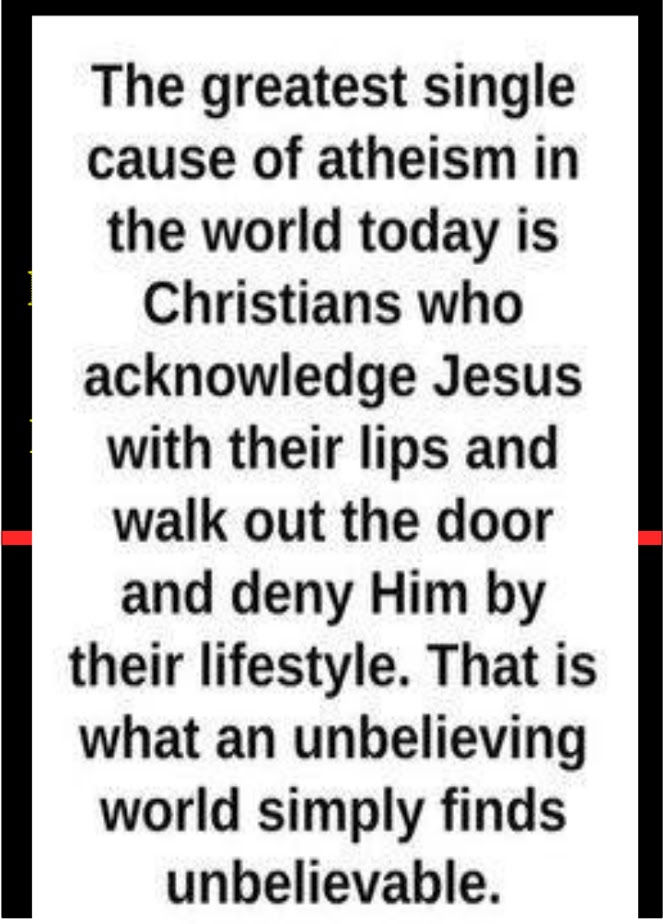
A journalist once asked Mahatma Gandhi what he thought of Western civilization and Christianity. He answered: "It's a good idea. They ought to try it". Similarly, we might urge followers of world religions: "Those are some nice moral principles. You ought to live by them." Reliable polls tell us that America is the most religious nation in the industrialized world. More that 90 percent of our population say they believe in God, and that they pray regularly. In his New Testament Epistle, James expressed the Christian view that "faith without works is dead." Similarly, Judaism calls for "mitzvah's" -- good deeds. And Islam also requires acts of charity. How do these sentiments translate into action? Let's look at our national religious behavior report card for a reality check.


  • America is the world's richest nation. Yet the U.S. Census Bureau reports that 54 million Americans live in poverty. That includes one in four children. If another country was doing this to ourselves and our children, we'd be at war. Why aren't we doing more to help out the weak, the vulnerable, the disenfranchised, and the weary? Why do so many prosperous people keep it all to themselves?
  • We are a religious nation, and yet: The U.S. poverty rate is the absolute worst among developed nations according to the Organization for Economic Cooperation and Development. Demographers say that the poverty rate will rise this year from 21 percent to 27 percent, which will be the highest percentage since the government began calculating poverty figures in 1959. Fifty four million Americans are on food stamps (the highest ever) and the number is expected to rise above fifty six million by the end of 2019.
  • We are a religious nation, and yet: According to the Census Bureau, 19 million people lived in working-poor families in 2008. The 2010 census showed a much higher figure approaching 24%. As of 2016, the last year demographics are available, that number is approaching one third. Things are close to becoming exponentially worse! The Feeding America Network reports that only 36 percent of their client households have one or more adults working. These are people who want to work but can't find jobs, or who can't feed their kids or themselves because they only make minimum wage. For this to happen in the richest country in the world is inexcusable!!
  • We are a religious nation, and yet: The National Law Center on Homelessness and Poverty estimates that 700,000 to 2 million people are homeless on any given night in America. Here in Atlanta where I reside, estimates of the homeless population on any given night range from 3,000-10,000 people. Also, a new class has emerged in America: the working homeless. The current minimum wage of $7.25 hourly here in Georgia and elsewhere (primarily “right to work” states like Georgia) is pitifully insufficient income for a single person to rent an apartment, let alone a family.
  • We are a religious nation, and yet: The elderly, the poor and others on fixed incomes are often forced to choose between food and medicine. Speaking as a retired technology professional and an Internet pastor who worked for 35 years in the professional world, this is a social outrage and an economic injustice that I have personally experienced. Speak up for the less fortunate, because you have a better than even chance you may wind up that way yourself some day!
  • We are a religious nation, and yet: 56 million Americans, including 26 million children, experienced hunger or the risk of hunger in 2016. That's more than a fourth of all households. According to the U.S. Department of Agriculture, hunger in American households has nearly doubled in the last five years. As I write this in early 2018, this number has swelled to at least 54 million, and the number of underfed American kids is approaching 28%. In the richest country in the world, this is simply inexcusable! We have to do something, and by writing this I'm trying to help accomplish exactly that.
  • We are a religious nation, and yet: American restaurants throw away more than 6,000 tons of food every day and grocery stores discard an estimated thirty million pounds of food daily. The U.S. Department of Agriculture's Food Loss Project estimates that Americans throw out 25.9 million tons of food each year. More disturbing: a University of Arizona study reports that 40 to 50 percent of all food ready for harvest never gets eaten. America's wastefulness is downright sinful in the sight of the Lord; there is no better way to describe it.
  • We are a religious nation, and yet: The United States is the only industrialized nation that doesn't provide very low cost health care for all its citizens. So-called “Obamacare” promised to correct much of that, but it is nowhere near enough. All the president and Congress had to do was to put the whole country on Medicare. Doing so would eliminate the need for Medicaid, saving over half a billion dollars annually, and if Obamacare were to be merged together with Medicare, the extra expenditures for Obamacare would be eliminated as well. And, we would have one health care system for the entire country.
  • We are a religious nation, and yet: We have the best medical technology and treatment capability in the world. Yet the United States ranks 37th for health care system performance by the World Health Organization. Why is this so?
  • We are a religious nation, and yet: The latest report on life expectancy shows a slight drop in the United States that will place us even lower than the current ranking of 49th among nations of the world – a lower life expectancy than many less developed countries. A Columbia University study attributes our decline from 11th place in 1950 to the much lower present ranking to our inadequate profit-driven health care system.
  • We are a religious nation, and yet: The current US minimum wage of $7.25 hourly for roughly two thirds of the country, which was raised from $5.15 four years prior to that, still keeps families stuck at or below the poverty line. France, Ireland, Luxembourg, the Netherlands, England, the Isle of Man, and many other nations – particularly Australia – have a much higher minimum wage than we do.
  • We are a religious nation, and yet: The latest census figures show the gap between rich and poor widening to the largest margin ever. The top 20 percent of workers earning more than $100,000 a year received 49.4.percent of all income compared with the 3.4 percent earned by the bottom 20 percent. The richest 1 percent pockets more than 30 percent of total income which is greater than the total amount earned by the bottom 50 percent combined. Economic inequality – not just in the US but globally – is a ticking time bomb waiting to go off, and when it does, the greed-based capitalist economic system we are currently stuck with will have to submit to a complete make-over or face extinction.
  • We are a religious nation, and yet: The wealthiest segment of the population is fighting tooth and nail for lower tax rates and other tax breaks while joblessness, poverty, crime, homelessness and hunger are rampant in America.
  • We are a religious nation, and yet: In 1994 a million innocents were slaughtered in Rwanda. We watched and did nothing. Similarly, we did little to stop the genocide in Darfur. Further slaughter is now ongoing in Syria, Somalia, Iraq and Yemen while the world watches and does nothing. Will U.S. “leadership” intervene on humanitarian grounds? History does not suggest a positive answer. Nor do the Scriptures, where regarding such people it is written, “Let the blood of our sins be on ourselves and our children!” (Matthew 27: 25) And so it is, unless God starts seeing some major changes of heart among us all.
  • We are a religious nation, and yet: There are at least 59 Holocaust museums in the United States dedicated to raising awareness of the Nazi genocide and to help prevent similar horrors from ever happening again. Add to that the numerous holocaust museums and memorials around the world. Yet genocides, mass murders, school shootings and other atrocities such as child sex slave trafficking persist. Who are the customers for these pimps? Who is supplying the weapons to these mass shooters?Who is taking decisive action, who is pretending, and who is doing nothing except complaining? Some of us need to put our Christian money where our mouths are.
  • We are a religious nation, and yet: Americans make up 5 percent of the world's population, and yet our country produces 25 percent of worldwide carbon dioxide emissions, which are raising the earth's temperature ("greenhouse effect") to dangerous levels. How is it that we are trashing the planet God created for each of us, while continuing to profess our love for its Maker?
  • We are a religious nation, and yet: Fossil fuel consumption is destroying the planet, but we refuse to develop a "Manhattan Project" for alternative energy, nor do we have one for battery technology so we can park the majority of our gas and diesel burning cars and trucks, something that is sorely needed.
  • We are a religious nation, and yet: Scientists warn that the environmental doomsday clock is ticking. The icebergs are breaking away and melting before our eyes, revealing islands we never saw before. We watch and debate but do too little to preserve the environment for ourselves and future generations. In our hubris we forget that we are guests on a tiny rock floating – in an infinite universe of rocks – that uniquely supports life in a delicate balance of natural and mysterious forces.
  • We are a religious nation, and yet: Smoking continues to compromise the health of more than 20 percent of our population. The Surgeon General tells us that cigarette, pipe and cigar smoking, in addition to contributing to a number of cancers, increases the risk of almost every known disease. The American Lung Association reports that each day nearly 6,000 teens under 18 years of age start smoking. But we refuse to put an end to tobacco use. At the same time, medical and recreational marijuana is still illegal at the federal level while having been proved to be not only harmless, but with significant medical uses and benefits. In so doing, we have criminalized a creation of Almighty God's (see Genesis 1: 11) that does no harm, while allowing the use of one that does!
  • We are a religious nation, and yet: Leaders of some of our biggest corporations and privately held firms, as well as prominent investment advisers (men and women of "faith"), have cheated, deceived and destroyed their companies and clients, ruining the lives and futures of untold numbers of individuals and families for their own profit.
  • We are a religious nation, and yet: We have the largest prison population in the world. Currently more than 3 million people are incarcerated, 1 in every 18 adults is in prison, on parole or probation adding up to a total of over 10 million. One out of every eight Americans you see on the street or in traffic has a criminal conviction in their background. The U.S has a greater prison population (in percentage of population) than many countries that we consider to be in violation of human rights.
  • We are a religious nation, and yet: According to the Stockholm International Peace Research Institute, world military spending for 2012 reached $1.531 trillion, a six percent increase over 2008 and a forty-nine percent increase over the year 2000. The United States accounted for forty-six percent of the total world military expenditure ($661 billion). China was a distant second accounting for 6.6. percent followed by France's 4.2 percent, the UK's 3.8 percent and Russia's 3.5 percent. The proposed U.S. military budget for 2018 is $886 billion. Nice job, Washington!


What is religion? Organized religion is a multi-billion-dollar business disguised as a honeycomb of non-profits (actually, more like a hornet's nest). On the other hand, followers of Jesus – who Himself was crucified mainly because he preached against organized government and organized religion – exercise the very essence of true Spirituality by showing love, caring, serving, giving, sharing, oneness, brotherhood and sisterhood, compassion, empathy and selflessness. Summed up: "Love thy neighbor as thyself." I'm so glad that we are a religious nation. If only we were all Christian too....