Showing posts with label hunger. Show all posts

Monday, February 18, 2019

Ending poverty must be done one person at a time

Commentary this week on the Progressive Christian Blog with Author & Web Minister Paul J. Bern; Living out the commands of Christ by helping the poor whenever we can -- https://www.pcmatl.org/weekly-commentary #compassion #empathy #realChristianity
 

Sunday, November 4, 2018

It's More Blessed to be Poor in God's Sight Than It Is To Be Rich

Those Who Are Living Paycheck to Paycheck
Are More Blessed Than They Realize
by Pastor Paul J. Bern
To view this on my website, click here :-)


I don't have to explain what's been happening to the US Middle Class over the last 35 years or so. Many people who used to be Middle Class in America are now poor. I should know, since I used to make a whole lot more money than I do now. But that was before the bottom fell out of everything. I've been there, done that and bought the T-shirt. Everyone is lamenting because they're living paycheck to paycheck and they don't know what to do about it. Going to the ballot box, so far, has produced an exacerbation of America's political problems – exactly the opposite of what is intended. Now we have people talking about civil war, and America's citizens are emigrating at record levels. The ones who are staying are buying guns and ammo at record levels. No wonder everyone is so tense and on edge!


That's why the purpose of this week's message is to console those who are angry and hurt, to counsel those who have been pushed aside or shown the door without just cause, and to reassure the frightened and confused. It's not hard to get pretty befuddled about current events. We live in a world of mass shootings in schools, work places, grocery stores and even churches – or synagogues, as was the case recently. Things have gotten so bad that we can't even attend church or go out for a movie without having to be alert for anyone carrying a weapon. There is a good side to being poor, and a positive thing about being oppressed, according to the Word of God (or the Bible, if you prefer). Allow me to cite a few examples from Scripture.


My first example is that of the apostle James, who was a very astute individual, and so his writings are something to take very seriously regardless of one's religious beliefs – or even a lack thereof. These words can still be beneficial regardless of faith. “5) Listen, my dear brothers and sisters: Has not God chosen those who are poor in the eyes of the world to be rich in faith and to inherit the kingdom he promised those who love him? 6) But you have dishonored the poor. Is it not the rich who are exploiting you? Are they not the ones who are dragging you into court? 7) Are they not the ones who are blaspheming the noble name of Him to whom you belong? 8) If you really keep the royal law found in Scripture, 'Love your neighbor as yourself,' you are doing right.” (James 2, verses 5-8)


Take heart if you are poor or otherwise financially hard pressed! Contrary to what many think and say, there is no shame in being poor. I was pretty well off at one time myself, mainly back in the 1990's through most of that decade, wrapping around to the early 2000's. I know what it's like to earn a six figure income, and to have to meet a payroll every week. But those days are gone for good, and there's little I can do about it except to keep on writing. I live on my small pension check, plus a little extra each month when I sell a book or two, and I've come to terms with that. But, what James wrote is even more true today than back then: “Is it not the rich who are exploiting you? Are they not the ones who are dragging you into court?” The student loan crisis is one modern example of this, foreclosures are another, and the so-called Drug War is yet another. Over half the people in state and federal prison are there for nonviolent drug offenses. America spends entirely too much money locking up all the wrong people.


“Has not God chosen those who are poor in the eyes of the world to be rich in faith and to inherit the kingdom he promised those who love him?” If you're poor, mentally depressed and running low on hope, then heed these words of the apostle James, the half-brother of Christ. To say this another way, it's better to be rich in faith than rich with worldly goods, and it's better to be poor in worldly goods than it is to be poor in faith. “If you really keep the royal law found in Scripture, “Love your neighbor as yourself,” you are doing right.” The much-beloved phrase, “Love your neighbor as yourself” is found first in Leviticus 19: 18, and it was an admonishment from the Lord Almighty to us all, that there be no hate among us – none at all! Judging by the racial tensions that simmer all across America, I'd say we have our work cut out for us as far as loving our neighbors – regardless of color.


Jesus himself was more blunt and direct than James in Luke's gospel when he said: “20) Looking at his disciples, he said: 'Blessed are you who are poor, for yours is the kingdom of God. 21) Blessed are you who hunger now, for you will be satisfied. Blessed are you who weep now, for you will laugh. 22) Blessed are you when people hate you, when they exclude you and insult you and reject your name as evil, because of the Son of Man. 23) Rejoice in that day and leap for joy, because great is your reward in heaven. For that is how their ancestors treated the prophets. 24) But woe to you who are rich, for you have already received your comfort. 25) Woe to you who are well fed now, for you will go hungry. Woe to you who laugh now, for you will mourn and weep. 26) Woe to you when everyone speaks well of you, for that is how their ancestors treated the false prophets.'” (Luke 6, verses 20-26)


The world's poor, sick and disabled, Jesus was saying, will be the first through the gates of heaven. If you hunger, you will be filled by Christ, not by McDonald's – Jesus guarantees it. Weep all you want for now, Jesus was saying, because in the end He will give us life and laughter everlasting. The more people hate you because of me, Jesus was teaching them, the greater your reward will be. So, let others hate you just because you will not hesitate to make a stand for Christ. Never mind Republican or Democrat, conservative, liberal or progressive – they all pale in comparison to the Spirit of our Lord and Savior. But in verses 24 and 25, Jesus taught that anyone who enriches themselves in this life does so at the expense of another, and those wealthy individuals risk paying an eternal price for being selfish beyond reason while others went hungry. Verses 24 through 26 could also be interpreted as a prophecy against America, but that would be another message for another time.


So, I want everyone reading this who is going through a hard time financially – and that would be the majority of you – to take heart in their situation. Granted, you are suffering and miserable, I know how you feel. But take it from a guy who's been there, you can and will survive the ordeal you are currently undergoing. If you can't raise your income, then find ways to cut your expenses. The main thing is knowing that Jesus is walking beside you in every conceivable way, every step of the way.


Sunday, September 9, 2018

Inequality Keeps Getting Worse, and God Sees All

A Few Comments on Inequality and Its Consequences
by Pastor Paul J. Bern
For a website view, click here :-)


If you want to solve a problem, start from the top down. We have been stuck in what are now antiquated concepts of representative democracy for 230 years. These days, we can go to Washington, DC via computer – the need to send other parties has become obsolete. Same goes for shareholder ownership of businesses as opposed to worker-owned or co-operative enterprises. Many people seem to believe that progress is getting other people to do more things for them, when quite the reverse is true. And I think that we’ve reached the point now where we’re stuck with a whole lot of unworkable concepts, so that when Michael Moore speaks about the number of people who make all this money and other people who don’t, it sounds as if we’re struggling for equality with them. Who wants to be equal to these guys? I think we have to be thinking much more profoundly, such as being on a higher plane of existence.


And I think that, talking about recovery, talking about democracy, we too easily get sucked into old notions of what we want. So we’re expecting protest. I don’t mind protests, and I encourage them at times. But what happened in 2001 in Porto Alegre, Brazil, or in Fergusom, Mo. In 2012 – when people gathered to say another world is necessary, another world is possible, and another world is happening, I think that that’s what’s happening. I was there in October 2011 for the commencement of “Occupy DC” in Freedom Plaza in Washington, DC, and I felt honored and humbled to have been privileged to be a part of that historical event. It inspired me to write my second self-published book, “Occupy America: We Shall Overcome” that winter and spring. It is imperative that we take matters into our own hands. Don't trust your government, they have already been lying to all of us for decades. Take the initiative! Take a look over your shoulder and you will notice that there is no one standing behind you to do anything or to take care of any business for you. It's all on you, and it's all on all of us.


People are beginning to say the only way to survive the early 21st century is to batten down the hatches. So they are building underground bunkers and stocking them with non-perishable foods, water, firearms and ammunition. In so doing they have voluntarily devolved as human beings. Don't forget what Christ said about that, “He who lives by the sword will die by the sword”. Otherwise all our time will be wasted by a mad scramble of those who compete with others instead of co-operating with them. All our efforts must instead be devoted to taking care of one another by recreating our relationships to one another. Let me point out a few examples.


In the first place, the US is still the only developed country in the world that has no comprehensive national health insurance (forget Obama-care, it's actually a new tax in disguise) and no family leave for workers. That's right, nobody but us. The very people who call these two basic human rights “socialism” are the ones who are profiting off the existing system the most. Thomas Jefferson once said, “The first and foremost duty of any government is to see to the needs of its people.” I think that sums it up perfectly.


The second example are wages, which are downright pathetic. Having been an IT professional for over 20 years, I clearly remember how wages began falling around 2000-2001 around the time of the dot-com crash. By the time I had left the business in 2012, the bottom had fallen out as far as wages were concerned. Jobs that paid $20-25.00 an hour were going for $12.00, and older workers like myself found ourselves shut out of the tech job market for good. Today as I write this, the minimum wage remains at a paltry $7.25 cents per hour here in Atlanta where I live. And what are these pitifully poor people supposed to do with $7.25 an hour? Buy lollipops? The minimum wage works out to a take-home pay of about $845.00 per month after taxes and Social Security, not counting state taxes. Go try to live on that for a month or even a week!


Many thousands of American families are being forced into into the streets due to circumstances beyond their control. In short, we are exactly where the government wants us: powerless! Take away every available resource we have and we're helpless. The solution is a realistic minimum wage that will also serve to jump-start America's economy again. Based on the cost of living for a family of four, which would include housing, utilities, internet access, transportation, clothing and medical care, that would work out to about $14.00 an hour for bare essentials. This should be something people are out protesting in the streets about. We want a living wage, now!!


As you can see, our problems can be fixed without having to re-invent the wheel. You don't have to be an economic genius – if indeed there is really such a thing – to figure out some basic, common sense solutions to get America's middle class back to work. Otherwise I fear that too many more formerly middle class Americans like so many of us will fall into the cracks in the sidewalk and disappear.

Sunday, September 2, 2018

We can eliminate poverty in a generation. So why aren't we?

How We Can Make God, and Each Other,
Happy by Ending Poverty
by Pastor Paul J. Bern
For better phone, tablet or website viewing, click here :-)


Today in the early 21st century, and with 99% of the wealth in America in the hands of 1% of the population, the US has a bigger and wider gap between the richest 1% of American money earners and big business owners and the remainder of working Americans than there is in many supposedly “third world” countries. The widespread and systemic unemployment or underemployment that currently exists in the US job market (including those who have given up and dropped out of the job market) is no longer just an economic problem. It has become a civil rights issue of the highest priority. The US job market has been turned into a raffle, where one lucky person gets the job while entire groups of others get left out in the cold – sometimes literally. I am vigorously maintaining that every human being has the basic, God-given right to a livelihood and to a living wage. There is no such thing under God's laws that say any given person should be unable to support themselves and their families! Anything less becomes a gross civil rights violation. Based on that, I would say those jobless individuals are victims of systemic economic discrimination. And so I further state unreservedly that restarting the civil rights era protests, demonstrations, sit-ins and the occupation of government buildings, or whole city blocks, is the most effective way of addressing the rampant inequality and persistent economic hardship that currently exists in the US.


Fortunately, this has already started here in the US, with the advent of the protests for so many unarmed Black men being killed by police officers. But these protesters are actually somewhat behind the curve. Because, before them there was Occupy Wall St., “we are the 99%” and Anonymous. And before those there was the Arab Spring in Egypt, the summer of 2011 in Great Britain and Greece, plus Libya, Syria and Gaza in the Middle East. So from a political standpoint, the current crop of protesters here in the US have some catching up to do. And yet, that was before the rest of the world got on board protesting globally for the many murdered Americans in Florida, Missouri, New York and elsewhere. So now, like an echo from the fairly recent past, the protests over police violence has echoed across the globe and is still reaching a crescendo.


The least common denominator to all this rage in the streets is that of being economically disadvantaged. “You will always have the poor”, Jesus said, “but you will not always have me” (This was prior to his being crucified). Deuteronomy chapter 15, verses 7-8 state, “If there is a poor man among your brothers.... do not be hardhearted or tightfisted toward your brother. Rather be open handed and freely lend him whatever he needs.” People everywhere find themselves surrounded by wealth and opulence, luxury and self-indulgence, while they are themselves isolated from it. It is one thing to be rewarded for success and a job well done. But it's an altogether different matter to have obscene riches flaunted in your face on a daily basis in order to remind certain people of their alleged inferiority. I think what we really need to do is find a way to end poverty. I can sum up the answer in two words: Free Education. Otherwise those who are poor will always remain so.


Who’s responsible for the poor? Back in the reign of the first Queen Elizabeth, English lawmakers said it was the government and taxpayers. They introduced the compulsory “poor tax” of 1572 to provide peasants with cash and a “parish loaf.” The world’s first-ever public relief system did more than feed the poor: It helped fuel economic growth because peasants could risk leaving the land to look for work in town. By the early 19th century, though, a backlash had set in. English spending on the poor was slashed from 2 percent to 1 percent of national income, and indigent families were locked up in parish workhouses. In 1839, the fictional hero of Oliver Twist, a child laborer who became a symbol of the neglect and exploitation of the times, famously raised his bowl of gruel and said, “Please, sir, I want some more.” Today, child benefits, winter fuel payments, housing support and guaranteed minimum pensions for the elderly are common practice in Britain and other industrialized countries. But it’s only recently that the right to an adequate standard of living has begun to be extended to the poor of the developing world.


In an urgent 2010 book, “Just Give Money to the Poor: The Development Revolution from the Global South”, three British scholars showed how the developing countries are reducing poverty by making cash payments to the poor from their national budgets. At least 45 developing nations now provide social pensions or grants to 110 million impoverished families — not in the form of charitable donations or emergency handouts or temporary safety nets but as a kind of social security. Often, there are no strings attached. It’s a direct challenge to a foreign aid industry that, in the view of the authors, “thrives on complexity and mystification, with highly paid consultants designing ever more complicated projects for the poor” even as it imposes free-market policies that marginalize the poor. “A quiet revolution is taking place based on the realization that you cannot pull yourself up by your bootstraps if you have no boots,” the book says. “And giving ‘boots’ to people with little money does not make them lazy or reluctant to work; rather, just the opposite happens. A small guaranteed income provides a foundation that enables people to transform their own lives.”


There are plenty of skeptics of the cash transfer approach. For more than half a century, the foreign aid industry has been built on the belief that international agencies, and not the citizens of poor countries or the poor among them, are best equipped to eradicate poverty. Critics concede that foreign aid may have failed, but they say it’s because poor countries are misusing the money. In their view, the best prescription for the developing world is a dose of discipline in the form of strict “good governance” conditions on aid. According to The World Bank, nearly half the world’s population lives below the international poverty line of $2 per day. As the authors of Just Give Money point out, that’s despite decades of top-down, neo-liberal, extreme free-trade policies that were supposed to “lift all boats.” In Africa, South Asia and other regions of the developing “South,” the situation remains dire. Every year, according to the United Nations, more than 9 million children die before they reach the age of 5, and malnutrition is the cause of a third of these early deaths.


Just Give Money argues that cash transfers can solve three problems because they enable families to eat better, send their children to school and put a little money into their farms and small businesses. The programs work best, the authors say, if they are offered broadly to the poor and not exclusively to the most destitute. “The key is to trust poor people and directly give them cash — not vouchers or projects or temporary welfare, but money they can invest and use and be sure of,” the authors say. “Cash transfers are a key part of the ladder that equips people to climb out of the poverty trap.” Brazil, a leader of this growing movement, provides pensions and grants to 74 million poor people, or 39 percent of its population. The cost is $31 billion, or about 1.5 percent of Brazil’s gross domestic product. Eligibility for the family grant is linked to the minimum wage, and the poorest receive $31 monthly. As a result, Brazil has seen its poverty rate drop from 28 percent in 2000 to 17 percent in 2008. Data released on December 15th, 2017 by the Brazilian Institute of Geography and Statistics (IBGE) shows that nearly fifty million Brazilians, or just over 20 percent of the population, live below the poverty line, and have family incomes of R$387.07 per month – approximately $5.50 a day USD. In northeastern Brazil, the poorest region of the country, child malnutrition was reduced by nearly half, and school registration increased.


South Africa, one of the world’s biggest spenders on the poor, allocates $9 billion, or 3.5 percent of its GDP, to provide a pension to 85 percent of its older people, plus a $27 monthly cash benefit to 55 percent of its children. Studies show that South African children born after the benefits became available are significantly taller, on average, than children who were born before. “None of this is because an NGO worker came to the village and told people how to eat better or that they should go to a clinic when they were ill,” the book says. “People in the community already knew that, but they never had enough money to buy adequate food or pay the clinic fee.” In Mexico, an average grant of $38 monthly goes to 22 percent of the population. The cost is $4 billion, or 0.3 percent of Mexico’s GDP. Part of the money is for children who stay in school: The longer they stay, the larger the grant. Studies show that the families receiving these benefits eat more fruit, vegetables and meat, and get sick less often. In rural Mexico, high school enrollment has doubled, and more girls are attending.


India guarantees 100 days of wages to rural households for unskilled labor, paying at least $1.25 per day. If no work is available, applicants are still guaranteed the minimum. This modified “workfare” program helps small farmers survive during the slack season. Far from being unproductive, the book says, money spent on the poor stimulates the economy “because local people sell more, earn more and buy more from their neighbors, creating the rising spiral.” Pensioner households in South Africa, many of them covering three generations, have more working people than households without a pension. A grandmother with a pension can take care of a grandchild while the mother looks for work. Ethiopia pays $1 per day for five days of work on public works projects per month to people in poor districts between January and June, when farm jobs are scarcer. By 2008, the program was reaching more than 7 million people per year, making it the second largest in sub-Saharan Africa, after South Africa. Ethiopian recipients of cash transfers buy more fertilizer and use higher-yielding seeds.


In other words, without any advice from aid agencies, government, or nongovernmental organizations, poor people already know how to make profitable investments. They simply did not have the cash and could not borrow the small amounts of money they needed. A good way for donor countries to help is to give aid as “general budget support,” funneling cash for the poor directly into government coffers. Cash transfers are not a magic bullet. Just Give Money notes that 70 percent of the 12 million South Africans who receive social grants are still living below the poverty line. In Brazil, the grants do not increase vaccinations or prenatal care because the poor don’t have access to health care. A scarcity of jobs in Mexico has forced millions of people to emigrate to the U.S. to find work. Just Give Money emphasizes that to truly lift the poor out of poverty, governments also must tackle discrimination and invest in health, education and infrastructure.


The notion that the poor are to blame for their poverty persists in affluent nations today and has been especially strong in the United States. Studies by the World Values Survey between 1995 and 2000 showed that 61 percent of Americans believed the poor were lazy and lacked willpower. Only 13 percent said an unfair society was to blame. But what would Americans say now, in the wake of the housing market collapse, the bailout of the banks and the phony economic “recovery”? The jobs-creating stimulus bill, the expansion of food stamp programs and unemployment benefits — these are all forms of cash transfers to the needy. I would say that cash helps people see a way out, no matter where they live. Not only that, the Bible condemns those who refuse to help the poor, as it is written in the Book of Proverbs: “He who oppresses the poor shows contempt for their maker” (chapter 14: 31), and again it is written, “Rich and poor have this in common: The same Almighty God has made them both.” (chapter 22: 2).


Sunday, December 14, 2014

It turns out ending poverty is much easier than many people think

Ending Poverty: How We Can Make God, and Each Other, Happy
by Rev. Paul J. Bern
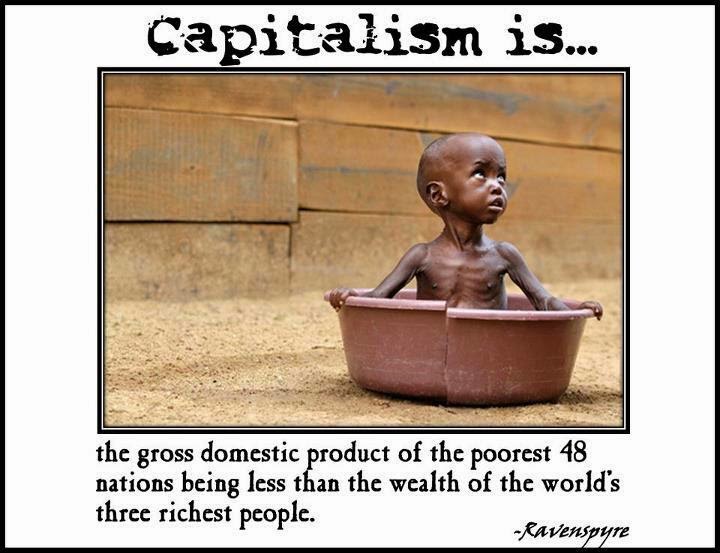

With about 99% of the wealth in America in the hands of a little over 1% of the population, the US has a bigger and wider gap between the richest 5% of American money earners and big business owners and the remainder of working Americans than there is in many supposedly “third world” countries. The widespread and systemic unemployment or underemployment that currently exists in the US job market is no longer just an economic problem, it has – here in the early 21st century – become a civil rights issue. The US job market has been turned into a raffle, where one lucky person gets the job while entire groups of others get left out in the cold – sometimes even literally. I am vigorously maintaining that every human being has the basic, God-given right to a livelihood and to a living wage. Anything less becomes a civil rights violation and therefore that jobless person(s) are victims of systemic discrimination. And so I state unreservedly that restarting the civil rights era protests, demonstrations, sit-ins and the occupation of whole buildings or city blocks is the most effective way of addressing the rampant inequality and persistent economic hardship that currently exists in the US.


Fortunately, this has already started here in the US, with the advent of the protests for Trayvon Martin, Michael Brown and Eric Garner. But these protesters are behind the curve. Because before them there was Occupy Wall St., “we are the 99%” and Anonymous. And before them there was the Arab Spring in Egypt, the summer of 2011 in Great Britain and Greece in Europe, and Libya, Syria and Gaza in the Middle East. So from a political standpoint, the current crop of protesters here in the US had some catching up to do. But that was before the rest of the world got on board protesting globally for the three murdered Americans in Florida, Missouri and New York. So now, like an echo from the fairly recent past, the protests over police violence has echoed across the globe and is still reaching a crescendo. The least common denominator to all this rage in the streets is that of being economically disadvantaged. People everywhere find themselves surrounded by wealth and opulence, luxury and self-indulgence, while they are themselves isolated from it. It is one thing to be rewarded for success and a job well done. But it's an altogether different matter to have obscene riches flaunted in your face on a daily basis just because someone can. I think what we really need to do is find a way to end poverty. I can sum up the answer in one word: Education. Otherwise those who are poor will always remain so.


Who’s responsible for the poor? Back in the reign of the first Queen Elizabeth, English lawmakers said it was the government and taxpayers. They introduced the compulsory “poor tax” of 1572 to provide peasants with cash and a “parish loaf.” The world’s first-ever public relief system did more than feed the poor: It helped fuel economic growth because peasants could risk leaving the land to look for work in town. By the early 19th century, though, a backlash had set in. English spending on the poor was slashed from 2 percent to 1 percent of national income, and indigent families were locked up in parish workhouses. In 1839, the fictional hero of Oliver Twist, a child laborer who became a symbol of the neglect and exploitation of the times, famously raised his bowl of gruel and said, “Please, sir, I want some more.” Today, child benefits, winter fuel payments, housing support and guaranteed minimum pensions for the elderly are common practice in Britain and other industrialized countries. But it’s only recently that the right to an adequate standard of living has begun to be extended to the poor of the developing world.


In an urgent 2010 book, “Just Give Money to the Poor: The Development Revolution from the Global South”, three British scholars show how the developing countries are reducing poverty by making cash payments to the poor from their national budgets. At least 45 developing nations now provide social pensions or grants to 110 million impoverished families — not in the form of charitable donations or emergency handouts or temporary safety nets but as a kind of social security. Often, there are no strings attached. It’s a direct challenge to a foreign aid industry that, in the view of the authors, “thrives on complexity and mystification, with highly paid consultants designing ever more complicated projects for the poor” even as it imposes free-market policies that marginalize the poor. “A quiet revolution is taking place based on the realization that you cannot pull yourself up by your bootstraps if you have no boots,” the book says. “And giving ‘boots’ to people with little money does not make them lazy or reluctant to work; rather, just the opposite happens. A small guaranteed income provides a foundation that enables people to transform their own lives.”


There are plenty of skeptics of the cash transfer approach. For more than half a century, the foreign aid industry has been built on the belief that international agencies, and not the citizens of poor countries or the poor among them, are best equipped to eradicate poverty. Critics concede that foreign aid may have failed, but they say it’s because poor countries are misusing the money. In their view, the best prescription for the developing world is a dose of discipline in the form of strict “good governance” conditions on aid. According to The World Bank, nearly half the world’s population lives below the international poverty line of $2 per day. As the authors of Just Give Money point out, that’s despite decades of top-down, neo-liberal, extreme free-trade policies that were supposed to “lift all boats.” In Africa, South Asia and other regions of the developing “South,” the situation remains dire. Every year, according to the United Nations, more than 9 million children die before they reach the age of 5, and malnutrition is the cause of a third of these early deaths.


Just Give Money argues that cash transfers can solve three problems because they enable families to eat better, send their children to school and put a little money into their farms and small businesses. The programs work best, the authors say, if they are offered broadly to the poor and not exclusively to the most destitute. “The key is to trust poor people and directly give them cash — not vouchers or projects or temporary welfare, but money they can invest and use and be sure of,” the authors say. “Cash transfers are a key part of the ladder that equips people to climb out of the poverty trap.” Brazil, a leader of this growing movement, provides pensions and grants to 74 million poor people, or 39 percent of its population. The cost is $31 billion, or about 1.5 percent of Brazil’s gross domestic product. Eligibility for the family grant is linked to the minimum wage, and the poorest receive $31 monthly. As a result, Brazil has seen its poverty rate drop from 28 percent in 2000 to 17 percent in 2008. In northeastern Brazil, the poorest region of the country, child malnutrition was reduced by nearly half, and school registration increased. South Africa, one of the world’s biggest spenders on the poor, allocates $9 billion, or 3.5 percent of its GDP, to provide a pension to 85 percent of its older people, plus a $27 monthly cash benefit to 55 percent of its children. Studies show that South African children born after the benefits became available are significantly taller, on average, than children who were born before. “None of this is because an NGO worker came to the village and told people how to eat better or that they should go to a clinic when they were ill,” the book says. “People in the community already knew that, but they never had enough money to buy adequate food or pay the clinic fee.”


In Mexico, an average grant of $38 monthly goes to 22 percent of the population. The cost is $4 billion, or 0.3 percent of Mexico’s GDP. Part of the money is for children who stay in school: The longer they stay, the larger the grant. Studies show that the families receiving these benefits eat more fruit, vegetables and meat, and get sick less often. In rural Mexico, high school enrollment has doubled, and more girls are attending. India guarantees 100 days of wages to rural households for unskilled labor, paying at least $1.25 per day. If no work is available, applicants are still guaranteed the minimum. This modified “workfare” program helps small farmers survive during the slack season. Far from being unproductive, the book says, money spent on the poor stimulates the economy “because local people sell more, earn more and buy more from their neighbors, creating the rising spiral.” Pensioner households in South Africa, many of them covering three generations, have more working people than households without a pension. A grandmother with a pension can take care of a grandchild while the mother looks for work. Ethiopia pays $1 per day for five days of work on public works projects per month to people in poor districts between January and June, when farm jobs are scarcer. By 2008, the program was reaching more than 7 million people per year, making it the second largest in sub-Saharan Africa, after South Africa. Ethiopian recipients of cash transfers buy more fertilizer and use higher-yielding seeds.


In other words, without any advice from aid agencies, government, or nongovernmental organizations, poor people already know how to make profitable investments. They simply did not have the cash and could not borrow the small amounts of money they needed. A good way for donor countries to help is to give aid as “general budget support,” funneling cash for the poor directly into govenment coffers. Cash transfers are not a magic bullet. Just Give Money notes that 70 percent of the 12 million South Africans who receive social grants are still living below the poverty line. In Brazil, the grants do not increase vaccinations or prenatal care because the poor don’t have access to health care. A scarcity of jobs in Mexico has forced millions of people to emigrate to the U.S. to find work. Just Give Money emphasizes that to truly lift the poor out of poverty, governments also must tackle discrimination and invest in health, education and infrastructure.


The notion that the poor are to blame for their poverty persists in affluent nations today and has been especially strong in the United States. Studies by the World Values Survey between 1995 and 2000 showed that 61 percent of Americans believed the poor were lazy and lacked willpower. Only 13 percent said an unfair society was to blame. But what would Americans say now, in the wake of the housing market collapse and the bailout of the banks? The jobs-creating stimulus bill, the expansion of food stamp programs and unemployment benefits — these are all forms of cash transfers to the needy. I would say that cash helps people see a way out, no matter where they live.