Wednesday, December 6, 2017

This week's ongoing Bible study will be part 2 of Luke chapter 23

An Innocent Man is Condemned

[Luke chapter 23, verses 13-31]
To view this on my website, click here :-)


Last week when we left off at verse 12 of chapter 23, King Herod II of Judea had just presided over Jesus being brought before him to be accused by those who sought to have him killed. After making a mockery of our Lord and Savior – after Jesus did the same to Herod by refusing to respond to Herod's line of questioning – King Herod sends Jesus back to Pilate with a big flowing robe that was not becoming of our Lord and Savior at all! Although the exact details are lost to history and antiquity, we can assume this robe made Christ look like a clown and not a King. There is, of course, a price to be paid for treating people so shamefully, especially when it's the Son of God. Today as we take up where we left off, Pontius Pilate has just convened another hearing upon Jesus' return. So let's all get started at verse 13.


“Pilate called together the chief priests, the rulers and the people, and said to them, 'You brought me this man as one who was inciting the people to rebellion. I examined him in your presence and have found no basis for the charges against him. Neither has Herod, for he sent him back to us; as you can see, he has done nothing to deserve death. Therefore I will punish him and then release him.' With one voice they cried out, 'Away with this man! Release Barabbas to us!' (Barabbas had been thrown into prison for insurrection in the city, and for murder.) Wanting to release Jesus, Pilate appealed to them again. But they kept shouting, 'Crucify him! Crucify him!' For the third time he spoke to them. 'Why? What crime has this man committed? I have found in him no grounds for the death penalty. Therefore I will punish him and then release him.' But with loud shouts they insistently demanded that he be crucified, and the shouts prevailed. So Pilate decided to grant their demand. He released the man who had been thrown into prison for insurrection and murder, the one they asked for, and surrendered Jesus to their will.” (Luke 23, verses 13-25)


We already know that Pilate didn't want to be bothered with Jesus, and that he regarded him as being more of a nuisance than anything else. Back in the days of the Roman Empire the emperors were worshiped as gods, and there were numerous Roman gods as well. So to Pilate, the very idea of someone being called 'the Son of God' must have seemed like a novelty to him at best, or maybe more like a curiosity. At any rate, Pilate plainly told the crowd he was finding Jesus not guilty as charged when he told them, “....as you can see, he has done nothing to deserve death. Therefore I will punish him and then release him.” At this point it's business as usual for Pilate, just another day at the office. And Pilate is telling the crowd, led by the Jewish Temple authorities, exactly who was in charge. He also was telling them he thought their charges against Jesus were completely over-the-top, which they most certainly were. But this was no ordinary day in Pilate's courts.


Abruptly and in unison, the people again demanded the release of Barabbas, but Pilate was unwilling. Evidently he thought Barabbas was a much bigger threat than Jesus Christ. Once again, on this count Pontius Pilate was absolutely right. “Wanting to release Jesus, Pilate appealed to them again. But they kept shouting, 'Crucify him! Crucify him!' For the third time he spoke to them. 'Why? What crime has this man committed? I have found in him no grounds for the death penalty.'” Pilate was now worried that he might have to condemn a man who should not receive capital punishment under Roman law. He worried that he might have a riot on his hands, something that would not have gone well with his superiors. In fact, Pilate had at this point tried twice to acquit Jesus and let him go, but was unsuccessful because the crowd had surrounded Jesus by now. This crowd of Jesus' accusers had become so agitated that they posed a direct threat to Jesus' safety, and by extension to Pilate himself. You can be sure one of the guards in Pilate's court had slipped out before this time to send for reinforcements. Jesus' accusers now outnumbered the authorities by a substantial margin, posing a significant threat to the court.


“....with loud shouts they insistently demanded that he be crucified, and the shouts prevailed. So Pilate decided to grant their demand.” Pilate caved in to the demands of the crowd, sacrificing Jesus' life in order to save his reputation and preserve his authority. Otherwise, he likely reasoned, he would be viewed by Rome as being expendable, and as being weak by those he governed. It was probably right about this time that the reinforcements I mentioned in the paragraph above arrived on the scene. And now let's move on to the second part of our study, beginning at verse 26.


“As they led him away, they seized Simon from Cyrene, who was on his way in from the country, and put the cross on him and made him carry it behind Jesus. A large number of people followed him, including women who had mourned and wailed for him. Jesus turned and said to them, 'Daughters of Jerusalem, do not weep for me; weep for yourselves and for your children. For the time will come when you will say, 'Blessed are the barren women, the wombs that never bore and the breasts that never nursed!' Then 'they will say to the mountains, 'Fall on us!' and to the hills, 'Cover us!'. For if men will do these things when the tree is green, what will happen when it is dry?'” (Luke 23, verses 26-31)


Verse 26 differs from other Biblical accounts of the details of Jesus' crucifixion, mainly the Catholic and Eastern Orthodox churches. They teach that Jesus had to carry his own cross, and that he fell three times while carrying it. According to the Vatican's account, it was only after Christ fell for the third time that Simon was compelled to carry Jesus' cross for him. This was symbolic of the number 3 being associated with the crucifixion of Christ, which is an occult symbol as well as in Christian Biblical numerology, which is why the Protestant denominations use the Biblical narrative that I'm using in place of the other. The problem with this is that it's just not true. What is true is that Jesus could not physically carry the cross because he had been beaten, whipped and otherwise physically abused to the point of exhaustion. Jesus literally had insufficient strength, because he had lost too much blood, to be strong enough to carry it. So, the Roman soldiers made Simon from Cyrene carry it instead. Let's not forget that this was a roughly made wooden cross big enough to hang a 175 pound man's body on to it. So you can be sure that this cross was very heavy, certainly well over 100 pounds, possibly weighing as much as 200.


In the same way that the (temporarily) condemned Jesus could not carry his cross, needing the assistance of a stranger, all of humankind cannot carry their crosses of guilt and shame, needing the risen Christ to carry all that for us. This is one of the profound truths of the Gospel that can never be diluted nor diminished. Jesus the risen Lord and Redeemer has borne the weight of all our sins on the cross of Golgotha. “A large number of people followed him, including women who had mourned and wailed for him. Jesus turned and said to them, 'Daughters of Jerusalem, do not weep for me; weep for yourselves and for your children.'” Jesus told them plainly they needed to weep and wail for their kids and grand-kids because of the condemnation that was now upon that current generation. They had all better hope, he was telling them, that their children would escape God's wrath that was to come.


“Then 'they will say to the mountains, 'Fall on us!' and to the hills, 'Cover us!'. For if men will do these things when the tree is green, what will happen when it is dry?'” Jesus was quoting from Hosea chapter 10 verse 8, which is a prophecy yet to be fulfilled. It refers to the End Times or the Last Days, when people will beg God to cover them from the oncoming wrath of God, the exact nature of which is still not entirely clear. But the Bible gives us a lot of hints and clues, some of which came from the Lord himself. “The Son of Man”, he said, “will come at an hour when you do not expect him.” There will be another world war that will kill at least 2.1 billion people. There will be an economic collapse, and the capitalist economic system will fall. Something like a meteor or a comet will hit the central Atlantic ocean, killing all the fish in the sea by contaminating the water, followed by a global earthquake of previously unheard-of proportions. All these things are coming, but not just yet. So in the meantime let's continue to get ourselves ready during this holiday season for His return for his Bride. And let's not forget that his supreme Sacrifice for us all is the real 'reason for the season'.

Sunday, December 3, 2017

THE WORLD IN 2018: The Prophecy Warning... (2017-2018 EVENTS)

Shame On All the Sex Predators! Out -- all of you, OUT!!

Humiliation and Shame for Sex Perverts is Deserved
by pastor Paul J. Bern
To view this on my website, click here :-)


I don't have to explain my topic for this week. Everybody has been watching or hearing about what has been going on in the halls of power in Washington as well as in Hollywood. Accusations of sexual assault, or lewd acts, or of randomly exposing oneself to whomever have suddenly started boiling to the surface. It started with former New York congressman Anthony Wiener, and he is now paying a very high price for his indiscretions in the form of a 21-month stint in federal prison. This was followed just a few months later by disclosure in Hollywood of producer-director Harvey Weinstien being accused of multiple counts of unwanted sexual advances and even outright assaults. Then several more Hollywood directors disclosed of their own sexual indiscretions, presumably to keep from being humiliated, followed by the flap over actor Kevin Spacey's allegedly uncontrollable sexual advances. While all this has been going on, president Trump has been accused by at least 20 women of unwanted sexual advances. Most recently, formerly popular Matt Lauer, the morning “Today” show host, was abruptly fired for his own incredibly poor judgment in failing to contain his own sexual appetites. On and on this goes, and where it stops nobody knows – except God.


My favorite book – the Bible – has plenty to say about sexual immorality. Everybody knows that, although not everyone believes in it. Allow me to name a couple of examples, and then I'd like to list a few bad things that can happen when we will not or cannot control our own sexual desires. First Corinthians chapter 6, verses 12 and 13 says, “'Everything is permissible for me' – but not everything is beneficial. 'Food for the stomach and the stomach for food' – but God will destroy them both. The body is not meant for sexual immorality, but for the Lord, and the Lord for the body.'” Having multiple sex partners in the times in which we live can be downright dangerous in a worst case scenario, particularly if your partner is already married or living with someone without telling you so. We think he/she is single but they're not, and next thing you know you-know-who comes home, and there you are. Some say, “Well, I don't care for the bar scene, so I use dating services to help me locate Mr. or Ms. Right so I can screen people first”. Let me point out that, according to data from the CDC located right here in Atlanta, 1 out of every 5 people on the dating websites have an STD. Out of those individuals, fully 80% don't bother to tell their new partners they are infected. You can imagine how that will turn out for everyone involved! The moral here is that, while we have the free will to do whatever we want, there can be an extremely high price to be paid when we abuse it.


Another example can be found further down in the same chapter of 1st Corinthians, verses 18-20, which read, “Flee from sexual immorality. All other sins a man commits are outside his body, but he who sins sexually sins against his own body. Do you not know that your body is a Temple of the Holy Spirit, who is in you, who you have received from God? You are not your own; you were bought at a price. Therefore honor God with your body.” The word 'flee' means to turn and run away from something or someone who poses a clear and present danger to yourself or your livelihood – even your very life! What happens during mass shootings? People turn and run for their lives, and that's exactly what we should do with regards to sexual immorality. That hot new partner you just stumbled upon could end up slowly killing you slowly long after the lovemaking is over – very, very slowly, in fact – with some STD that the newly infected person probably never heard of.


One final example I feel should be mentioned on the topic of sexual sins and perversion can be found in 1st Thessalonians chapter 5, verse 3, and I quote: “But among you there should not be even a hint of sexual immorality, or of any kind of impurity, or of greed, because these are improper for God's holy people.” OK, right here it is in black and white, everyone! God ranks having multiple partners right up there with the top 1% and all their insatiable greed. You know, they have 99% of America's wealth, while the remaining 99% are left with the remaining 1% – those people? Think of how much you likely despise those people, and that's how offended God is with our sexual immorality (Never mind how offended God is with their greed. I've already covered that topic extensively, and I will do so again, God willing!). This includes people – and particularly those who self-identify as 'Christians' – who hang out at nude or topless clubs, who look at porn, and in many cases even the singles bars should be off-limits to true Christian believers who are single. If anyone feels so lonesome that they would go to a night club and risk getting shot or stabbed just to find someone to love, I've got a news flash for those individuals – you won't find that special someone there. All you'll meet are a bunch of drunks, and who wants that? Those who truly desire a soul-mate should ask God to send him or her to you. Believe me, when the time is right, he will.


The apostle Paul, who wrote all the quotes I'm using today including this last one, said it best in this regard: “Now to the unmarried and the widows I say: It is good for them to stay unmarried, as I am. But if they cannot control themselves, they should marry, for it is better to marry than to burn with passion.” (1st Corinthians chapter 7, verses 8-9) Anyone who is really burning up with that much passion should go ahead and find a spouse to keep themselves from sinning – there is nothing wrong with this at all. But none of us – I am single myself – will find our future spouses on-line, or in some bar, no matter how fancy or attractive they may seem. Moreover, you will never find him or her watching porn either! If anyone really wants a spouse, they should pray to God to send them one, because when we do, and those prayers are made with the utmost sincerity, God will answer that prayer. That's one thing I know for sure. The other thing that we have all seen for ourselves on the news and other media is that, when we cannot contain or refuse to curb our sexual proclivities – or if certain people think they can get away with their unwanted sexual advances because of their status, wealth, or both – those days just came to a sudden and dramatic end! I, for one, am glad this has occurred. It happened for the good of our country and for ourselves. This series of incidents has proven conclusively that sexual immorality, when carried to its extremes, will destroy the lives of the perpetrators. Chalk one up for gender equality, for mutual respect, and for Jesus Christ, the originator of gender equality.

Friday, December 1, 2017

Discoveries of Ancient Relics that Do Not Fit The Time or Place

Free Book Excerpt #16 from Blogger and Author Rev. Paul J. Bern


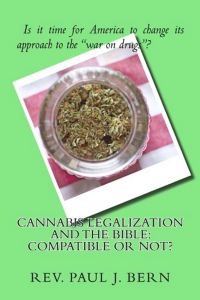
legalization cover 1

Another free sample from the latest book offering from Rev. Paul J. Bern; “Cannabis Legalization and the Bible: Compatible Or Not?”

Watch the video https://youtu.be/o_UXdIsBuf8


The United States likes to portray itself as the “Land of the Free”, yet a 2013 study by the ACLU found that one out of three people in the United States are arrested by the time they are 23! 1 out 3 arrested by the time they are 23?!? You want some more shameful stats? Last year there were more than 1.6 million people arrested on drug charges and over half of those arrests were for marijuana possession alone. With so many of our citizens in prison compared with the rest of the world, there are only two possibilities: Either we are home to the most evil people on earth or we are doing something much different – and vastly counterproductive. Obviously, the answer is the latter. It is time to find an exit strategy from our 40 year old war on drugs that is unquestionably a failure. Here's a few examples:


  • There are more African American adults under correctional control today – in prison or jail, on probation or parole – than were enslaved in 1850, a decade before the Civil War began.
  • As of 2004, more African American men were disenfranchised (due to felon disenfranchisement laws) than in 1870, the year the Fifteenth Amendment was ratified, prohibiting laws that explicitly deny the right to vote on the basis of race.
  • A black child born today is less likely to be raised by both parents than a black child born during slavery. The recent disintegration of the African American family is due in large part to the mass imprisonment of black fathers.
  • If you take into account prisoners, a large majority of African American men in some urban areas have been labeled felons for life. (In the Chicago area, the figure is nearly 80%.) These men are part of a growing under-caste – not class, caste – permanently relegated by law to a second-class status. They can be denied the right to vote, automatically excluded from juries, and legally discriminated against in employment, housing, access to education, and public benefits, much as their grandparents and great-grandparents were during the Jim Crow era.


The drug war has been brutal – complete with SWAT teams, tanks, bazookas, grenade launchers, and sweeps of entire neighborhoods – but those who live in white communities have little clue to the devastation wrought. This war has been waged almost exclusively in poor communities of color, even though studies consistently show that people of all colors use and sell illegal drugs at remarkably similar rates. In fact, some studies indicate that white youth are significantly more likely to engage in illegal drug dealing than black youth. Any notion that drug use among African Americans is more severe or dangerous is nullified by the data. White youth, for example, have about three times the number of drug-related visits to the emergency room as their African American counterparts. That is not what you would guess, though, when entering our nation’s prisons and jails, overflowing as they are with black and brown drug offenders. In some states, African Americans comprise 80%-90% of all drug offenders sent to prison. This is the point at which I am typically interrupted and reminded that black men have higher rates of violent crime. That’s why the drug war is waged in poor communities of color and not middle-class suburbs.


But what about all those violent criminals and drug kingpins? Isn’t the drug war waged in ghetto communities because that’s where the violent offenders can be found? The answer is yes – in made-for-TV movies. In real life, the answer is no. The drug war has never been focused on rooting out drug kingpins or violent offenders. Federal funding flows to those agencies that increase dramatically the volume of drug arrests, not the agencies most successful in bringing down the bosses. What gets rewarded in this war is sheer numbers of drug arrests. To make matters worse, federal drug forfeiture laws allow state and local law enforcement agencies to keep for their own use 80% of the cash, cars, and homes seized from drug suspects, thus granting law enforcement a direct monetary interest in the profitability of the drug market. The results have been predictable: people of color rounded up en masse for relatively minor, non-violent drug offenses. In 2005, four out of five drug arrests were for possession, only one out of five for sales. Most people in state prison have no history of violence or even of significant selling activity. In fact, during the 1990s – the period of the most dramatic expansion of the drug war – nearly 80% of the increase in drug arrests was for marijuana possession, a drug generally considered less harmful than alcohol or tobacco and at least as prevalent in middle-class white communities as in the inner city. In this way, a new racial under-caste has been created in an astonishingly short period of time – a new Jim Crow system. Millions of people of color are now saddled with criminal records and legally denied the very rights that their parents and grandparents fought for (and in some cases, died for). Affirmative action, though, has put a happy face on this racial reality. Seeing black people graduate from Harvard and Yale and become CEO's or corporate lawyers – not to mention the current president of the United States – causes us all to marvel at what a long way we’ve come. Recent data shows, though, that much of black progress is a myth. In many respects, African Americans are doing no better than they were when Martin Luther King, Jr. was assassinated and uprisings swept inner cities across America. The black child poverty rate is actually higher now than it was then. Unemployment rates in black communities rival those in Third World countries. And that’s with affirmative action! When we pull back the curtain and take a look at what our “colorblind” society creates without affirmative action, we see a familiar social, political, and economic structure: the structure of racial caste. The entrance into this new caste system can be found at the prison gate. This is not Martin Luther King, Jr.’s dream. This is not the promised land. The cyclical rebirth of caste in America is a recurring racial nightmare.


In a report published by reporter Tom McCarthy in The Guardian on Wednesday March 4th, 2015, police have killed more than twice as many people as reported by US government. According to this report, an average of 545 people killed by local and state law enforcement officers in the US went uncounted in the country’s most authoritative crime statistics every year for almost a decade. The first-ever attempt by US record-keepers to estimate the number of uncounted “law enforcement homicides” exposed previous official tallies as capturing less than half of the real picture. The new estimate – an average of 928 people killed by police annually over eight recent years, compared to 383 in published FBI data for the same time period – amounted to a more glaring admission than ever before of the government’s failure to track how many people police kill. 


The revelation called into particular question the FBI practice of publishing annual totals of “justifiable homicides by law enforcement” – tallies that are widely cited in the media and elsewhere as the most accurate official count of police homicides. This bureau of justice statistics (BJS) report, produced in collaboration with RTI International, the research institute, explodes the notion – if its findings are accurate – that the figures the FBI publishes annually are anything other than hugely misleading. The data underlying the FBI tally “is estimated to cover 46% of officer-involved homicides at best” for the years 2003-2009 and 2011, the BJS report concluded. But the published FBI tallies cover even fewer of the total deaths, closer to 41%, in part because the FBI publishes no data from Florida. A separate tally of “arrest-related deaths”, conducted by BJS itself, was slightly more accurate for the years in question, capturing 49% of law enforcement homicides, at best, the report found. The report estimated “an average of 928 law enforcement homicides per year” for the years in question, suggesting that the FBI’s published count of 414 such deaths in 2009, for example, might be 124% off, while its count of 347 such deaths in 2005 might be 167% off. The years under study saw several high-profile homicides by law enforcement of unarmed civilians, such as the 2009 shooting of Oscar Grant in a train station in Oakland, California – an episode that would become the subject of the award-winning film “Fruit vale Station” – and the 2006 killing of Sean Bell, who died in a hail of 50 bullets outside a nightclub in Queens, New York. But the majority of victims in law enforcement homicides for those years not only went unnamed – they went uncounted in any one tally. Even the two counting systems combined, as overseen by the FBI and BJS, missed an average of 263 homicides by law enforcement each year, BJS found.


Academics and specialists have long been aware of flaws in the FBI numbers, which are based on voluntary submissions by local law enforcement agencies of paperwork known as supplementary homicide reports. No law requires local agencies to fill out the reports, and some agencies do not, especially not for officer-involved homicides, according to experts who have studied the issue. But no accredited source had publicly ventured to claim that the numbers published by the FBI were more than 100% wrong. That’s notwithstanding an unusually public airing of doubts about the numbers by the FBI director, James Comey, in a 2015 speech at Georgetown University. “It’s ridiculous that I can’t tell you how many people were shot by the police in this country – last week, last year, the last decade – it’s ridiculous,” Comey said. While the FBI and other government tallies have long been criticized for under-reporting, an admission of the problem at the top levels of US government is swiftly emerging. Joining Comey and Obama this year has been the outgoing attorney general, Eric Holder, who in January 2016 called the government’s accounting for use of force “unacceptable”. In a highly anticipated investigation of its own, Holder’s Justice Department released a report the following Wednesday that African Americans were subject to a full 88% of use-of-force cases actually documented by the police in Ferguson, Mo., according to a law enforcement official familiar with the department’s findings.


I have presented everything in this book the way I have to reveal the government's not-so-surprising rationale for America's extremist drug laws – race. The first anti-drug law in our country was a local law in San Francisco passed in 1875. It outlawed the smoking of opium and was directed at the Chinese because opium smoking was a peculiarly Chinese habit. It was believed that Chinese men were luring white women to have sex in opium dens. In 1909 Congress made opium smoking a federal offense by enacting the Anti-Opium Act. It reinforced Chinese racism by carving out an exception for drinking and injecting tinctures of opiates that were popular among whites. Cocaine regulations also were triggered by racial prejudice. Cocaine use was associated with African-Americans just as opium use was associated with the Chinese. Newspaper articles bore racially charged headlines linking cocaine with violent, anti-social behavior by blacks. A 1914 New York Times article proclaimed: "Negro Cocaine 'Fiends' Are a New Southern Menace: Murder and Insanity Increasing Among Lower Class Blacks Because They Have Taken to 'Sniffing.'" A Literary Digest article from the same year claimed that "most of the attacks upon women in the South are the direct result of the cocaine-crazed Negro brain." It comes as no surprise that 1914 was also the year Congress passed the Harrison Tax Act, effectively outlawing opium and cocaine.


Marijuana prohibition also had racist underpinnings. This time it was the Mexicans. Just as cocaine was associated with black violence and irrational behavior, in the southwest border towns marijuana was viewed -- beginning in the early 1920s -- as a cause of Mexican lawlessness. A Texas police captain from that time period suggested that marijuana gave Mexicans superhuman strength to commit acts of violence: “Under marijuana Mexicans [become] very violent, especially when they become angry and will attack an officer even if a gun is drawn on him. They seem to have no fear. I have also noted that under the influence of this weed they have enormous strength and it will take several men to handle one man while, under ordinary circumstances, one man could handle him with ease.” The American Coalition – an anti-immigrant group – claimed as recently as 1980: "Marijuana, perhaps now the most insidious of narcotics, is a direct byproduct of unrestricted Mexican immigration."


Since then Congress has enacted a spate of comprehensive anti-drug laws with strict penalties. For example, today one can be sentenced to life for distributing one kilogram of heroin; 40 years for distributing 100 grams, and 20 years for distributing any quantity at all. Nevertheless, this has not stemmed the country's appetite for illicit drugs in spite of every administration's continued "war on drugs" since President Nixon established the Drug Enforcement Agency in 1972, which has grown through the years to a staff of almost 10,000 employees and a budget of $2 billion annually. According to data from the 2010 National Household Survey on Drug Use and Health, almost 120 million Americans 12 or older – roughly 47 percent of that population – reported illicit drug use at least once in their lifetime; 15.3 percent admitted to using an illegal drug in the prior year; and 8.9 percent – roughly 23 million people – did it within the prior month. The New York Times recently reported that one out of every 15 high school students smokes marijuana on a nearly daily basis. When it comes to sentencing, the main culprit is drugs. About half of the roughly 220,000 criminals in the federal prisons have either brought them into our country, have distributed them here, or have otherwise associated themselves with this illicit activity. This means that probably half of the $6.8 billion of the Bureau of Prisons budget is eaten up by incarcerating the criminal druggies. Half of the prison population is there because of drugs, costing us billions of dollars a year to keep them in jail.

Buy direct (print edition reduced to $9.95, 200 pages) at http://www.pcmatl.org/#!books-and-donations/c17et


Get it on Smashwords.com (all Apple/Mac devices, Nook, Kobo, Fire and more) at https://www.smashwords.com/books/view/666084

Wednesday, November 29, 2017

This week's ongoing Bible study will be part 1 of Luke chapter 23

Jesus Goes Before the Authorities
[Luke chapter 23, verses 1-12]
To view this on my website, click here :-)


After taking a break for Thanksgiving last week, I'd just like to say it's good to be back, and I thank God for restoring and refreshing me during my time of rest. I hope everyone did as well as I did, if not better! Two weeks ago when we finished up chapter 22, Jesus had just been brought before the Jewish authorities after being arrested by them in the middle of the night, something law enforcement has always been noted for. This week as we continue with part 1 of chapter 23, we find Jesus being brought before Pontius Pilate, who in turn sends our soon-to-be-risen Savior to King Herod for jurisdictional reasons. So let's get started with this week's lesson beginning at verse one.


“Then the whole assembly rose and led him off to Pilate. And they began accusing him, saying, 'We have found this man subverting our nation. He opposes paying taxes to Caesar and claims to be Christ, a king.' So Pilate asked Jesus, 'Are you the king of the Jews?' Yes, it is as you say,' Jesus replied. Then Pilate announced to the chief priests and to the crowd, 'I find no basis for a charge against this man.' But they insisted, 'He stirs up the people all over Judea by his teaching. He started in Galilee and has come all the way here.' Upon hearing this, Pilate asked if the man was a Galilean. When he learned that he was under Herod's jurisdiction, he sent him to Herod, who was also in Jerusalem at the time.” (Luke 23, verses 1-7)


So at this point Jesus has just made his court appearance before the Temple ruling body and quickly found 'guilty' of allegedly pretending to be the Messiah found in their own scriptures. As before, these scriptures were the Law and the prophets of old, what we now call the Old Testament, or what Jewish people call the Torah (pronounced Tor-AAH in Hebrew). The Temple authorities and chief priests, together with the Temple Guard who were presumably still there guarding Jesus, then brought him before Pilate to have Jesus charged with fomenting a revolt. They also bore additional false testimony, saying Jesus was opposed to taxation. Yet Christ had already said, “Then pay unto Caesar what is Caesar, and unto God what is God's.” (Luke 20: 25) But under Roman law at that time, this still evidently carried insufficient weight to even consider any prosecution.


“....'I find no basis for a charge against this man.' But they insisted, 'He stirs up the people all over Judea by his teaching. He started in Galilee and has come all the way here.'” As before, Pilate reminded the crowd of Jesus' accusers that the teachings of Christ did not legally constitute an insurrection against the Roman Empire. Then Herod sends Jesus to King Herod, who was king over Judea where Galilee was located, and who was the son of the elder King Herod, who had all the first-born male children under age 2 killed in Matthew chapter 2, verses 12-18. The irony of this is strikingly inescapable! The son of King Herod I, Herod II, was going to get an opportunity to prosecute Jesus under the law. To call this a conflict of interest would be a huge understatement! Herod II must have figured out that his father had not succeeded several decades before, and that Jesus had somehow escaped his father's 'baby dragnet'. So Herod II may have viewed this as an opportunity to avenge his deceased father. Now let's move on to the second half of today's study, beginning at verse 8.


“When Herod saw Jesus, he was greatly pleased, because for a very long time he had been wanting to see him. From what he had heard about him, he hoped to see him perform some miracle. He plied him with many questions, but Jesus gave him no answer. The chief priests and teachers of the law were standing there, vehemently accusing him. Then Herod and his soldiers ridiculed and mocked him. Dressing him in an elegant robe, they sent him back to Pilate. That day Herod and Pilate became friends – before that they were enemies.” (Luke 23, verses 8-12)


Based on the apostle Luke's narrative here, king Herod II saw Jesus as some kind of guru who would willingly perform for him in the hope of possibly being set free. The young Herod clearly had no clue as to the true identity of our Lord and Savior. But it was then that Herod found out why Jesus never came to see him, even though he had apparently extended an invitation that had been ongoing for at least a year or two. “He plied him with many questions, but Jesus gave him no answer.” All right, I'm sure you all remember the “Miranda rights” – 'you have the right to remain silent', etc. in the event someone gets arrested? This passage of scripture is the basis for that legal argument, as well as for the Supreme Court decision that followed it. Jesus never accepted any of Herod's invitations because Jesus already knew more about King Herod than Herod knew about himself. Just as surely as Jesus had ignored Herod's previous invitations, our Redeemer pointedly ignored every one of Herod's questions with remarkable steadfastness. As you can see, Herod became increasingly irritated at Jesus' refusal to respond in any way. So did our Lord's accusers.


Our Lord and Savior stood firmly and silently as the volume and the tempo to Herod's questioning increased to the tune of the accusers who had brought Jesus before King Herod. “The chief priests and teachers of the law were standing there, vehemently accusing him. Then Herod and his soldiers ridiculed and mocked him.” You will recall in our earlier studies of Luke's gospel how we observed a certain contingent of Hebrew scholars and high priests that shadowed Jesus and the Twelve everywhere they went. From town to town and from village to village, they straggled along pretending to be admirers until – at what seemed like just the right moment to them – they found opportunities to ask Jesus trick questions of one kind or another in the hopes of tripping him up or catching him in some sort of contradiction. As you also undoubtedly recall, Jesus would stymie the efforts of these 'religious leaders and teachers of the law' every single time. Moreover, this had been going on for at least the last couple of years. A huge expenditure of time and travel had been invested in this effort up to this point by the Temple leadership – and the Pharisees, Saduccees and Temple high priests had nothing to show for it. And by this time they were enraged at Jesus and everything he represented because they felt their livelihoods were threatened by what He taught. And, they were absolutely right.


So all of this had built up until this moment. It was the Hebrew religious leadership's first chance to strike, and they struck hard. Really, really hard, even to the point of obsession. The apostle Luke wrote that they were “vehemently accusing him”, and even that may be an understatement. “Dressing him in an elegant robe, they sent him back to Pilate. That day Herod and Pilate became friends....” All of the frustration the Temple leadership's inability to catch Jesus in a lie or a contradiction was erupting as this was occurring. On a scale of 1 to 10, with 1 being the lowest, I would classify this as a 99, and that's no joke either! These people were absolutely livid!


They were using a tactic similar to what the police use today. They were bullying and assaulting our Lord in the hopes of provoking Jesus – to see if they could make him snap (sound familiar?)! You know, so they could press additional charges. When that didn't work either, Herod sends Jesus back to Pilate, complete with his brand new “robe” which sealed the Lord's fate as well as Herod's own condemnation. Next week when we return, we'll get into detail about what happens next. Even if you've heard or read this story before, relating this Gospel of Luke in a Progressive interpretation so that it is most applicable in a 21st century frame of reference is why I write these Biblical studies on the various apostles (The Apostle Paul is already in print, you can learn more here). The more relevant I can make these ongoing studies, the larger audience I will attract, and that's what I'm here for. It's about souls, people. It's not about me, it's all about Christ Jesus our Lord! See you next week for part 2 of Luke chapter 23.